
How to Never Run Out of Things to Say (For Real)

You know the feeling. Things are going fine, then a question gets a one-word answer, and your brain starts scrolling for the next topic like a slot machine that won't land. Work. Pets. Weekend plans. You can feel the silence coming three seconds before it arrives, and there's nothing you can do to stop it.
Most guys think the fix is more material. More questions in the chamber, more interesting facts, a bigger list. So they cram. They walk into a date with a mental rolodex of fifteen topics and treat the night like a quiz they have to get through. That instinct is wrong for the reason set out in 250 questions and what the answers actually tell you: a list becomes an interrogation the moment you work through it in order.
That is exactly why it dies.
Running out of things to say is not a supply problem. You don't need more topics. You need to stop treating a conversation like a list of topics to burn through and start treating it like a thread you follow. This post is about how to do that, on a date and over text, so the silence stops showing up uninvited.
In This Post
- Why conversations actually die
- What most people get wrong about running out of things to say
- Why following threads works
- The playbook: how to keep a conversation going
- Advanced: walk in with her interests pre-loaded
- What to say when you run out of things to talk about over text
- Real examples: a dying conversation vs a flowing one
- The bigger picture
- FAQ
Why conversations actually die
Start with what people are actually doing when a conversation works versus when it stalls. A psychologist at the University of Arizona, Matthias Mehl, wired up 79 people with a recorder that captured 30-second snippets of their day, then sorted them by how happy they were. The happiest people had roughly one-third as much small talk and twice as many substantive conversations as the unhappiest.
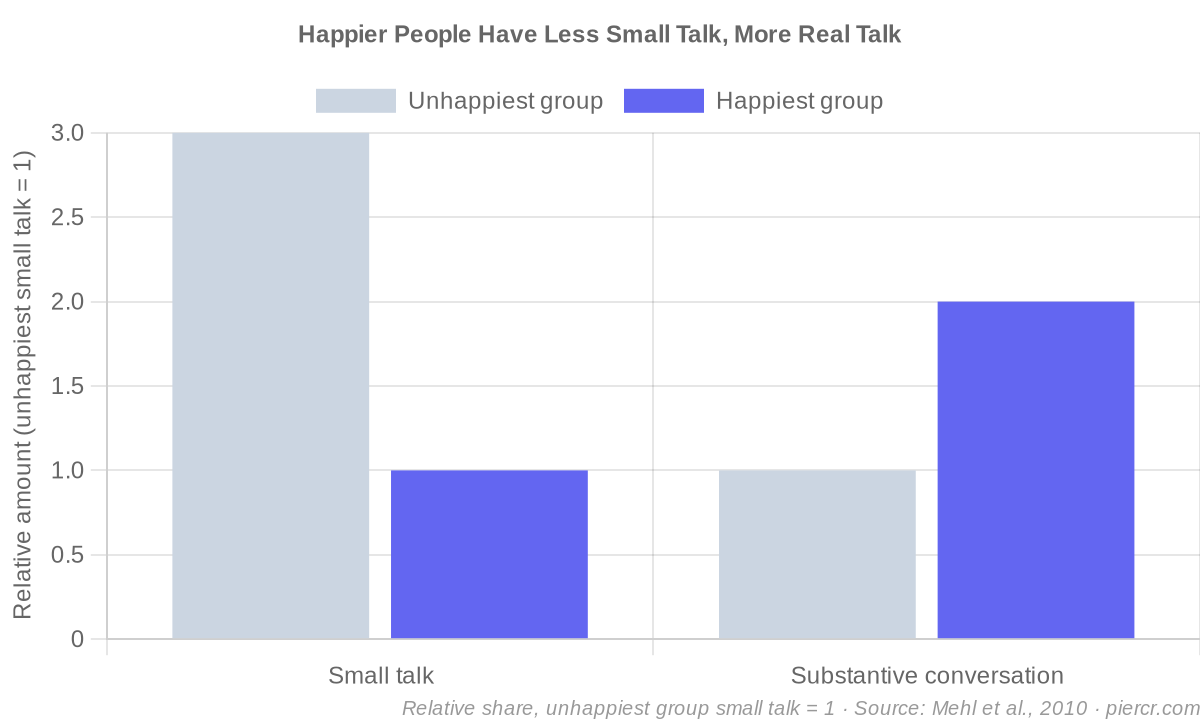
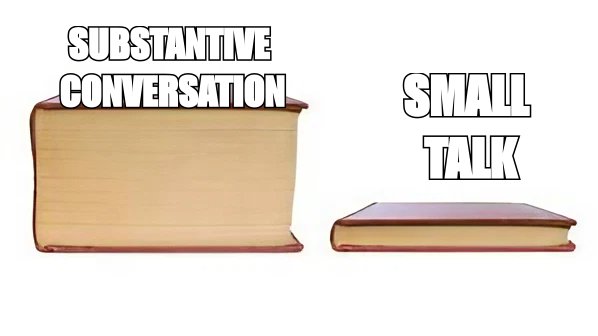
Notice what that does and doesn't say. It isn't that happy people talk about more things. They talk about fewer things, more deeply. The small-talk machine, where you toss out topic after topic and skim the surface of each, is the unhappy pattern. It's also the one that runs out of fuel, because surface topics are finite and you can feel yourself emptying the tank.
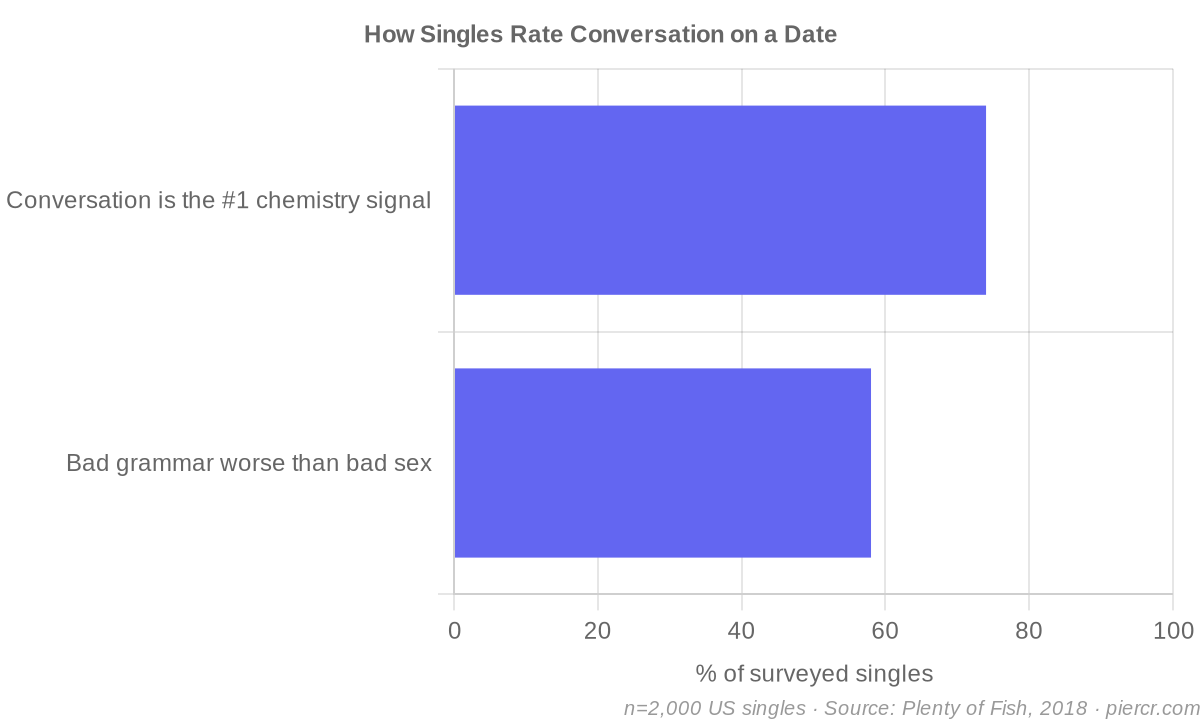
The other half of the problem is that conversation carries more weight than guys think it does. In a Plenty of Fish survey of 2,000 single adults, 74% said conversation is the number one indicator of chemistry, ahead of physical attraction. So when the talk dries up, she isn't just bored for a minute. She's reading it as a signal about how the two of you fit.
That's the stakes. Now the actual fix.
What most people get wrong about running out of things to say
Here's the thing most guys never get told: the panic is mostly in your head, and it's making you worse.
When you feel a conversation stalling, your attention turns inward. You start monitoring your own performance, scanning for the next thing to say, bracing for the silence. And the more airtime your own anxiety gets, the less you're actually listening to her, which is the only place the next thing to say was ever going to come from.
There's good research on the size of this misread. Psychologists Erica Boothby, Gus Cooney, Gillian Sandstrom, and Margaret Clark ran five studies and found a consistent pattern they named the "liking gap": after a conversation, people systematically underestimated how much their partners liked them and enjoyed their company. You walk away sure you bombed. She walked away thinking it went well. The gap persisted for several months among college dorm mates, so this isn't a first-impression blip. You are a bad judge of how you're landing, and you judge yourself harder than she does.
So the awkward pause you're terrified of is mostly your own scoreboard, not hers. She is not sitting there counting the seconds. You are.
The second mistake follows from the first. Because you feel the pressure, you fill it with a brand-new topic. She mentions she just got back from Lisbon, and instead of going anywhere with that, you say "cool" and pivot to "so do you have any siblings." You just walked past an open door to ask about the weather. The topic was right there. You changed the subject because you were too busy loading the next question to hear the answer to the last one.
Why following threads works
The mechanism is simple, and a Harvard study nailed it. Across three studies of live conversations, including face-to-face speed dating, Karen Huang and her colleagues found that people who ask more questions are better liked, and the effect was strongest for follow-up questions, the ones that prove you were listening. Speed daters who asked more follow-ups were more likely to get a second date.
A follow-up question does two jobs at once. It keeps the conversation moving without you having to invent anything, and it signals that you actually heard her. That second part is the whole game. Celeste Headlee, a radio host who has interviewed people for a living for decades and wrote a book on conversation, put the listening problem bluntly in her TED talk:
If your mouth is open, you're not learning.
A thread is just a topic you keep pulling on instead of dropping. She says she got back from Lisbon. The checklist guy says "nice, how about your job." The thread guy asks what took her there, what she'd go back for, whether she travels alone or drags friends along. Same starting topic, four more minutes of real conversation, and every one of those answers hands him three new threads to pull.
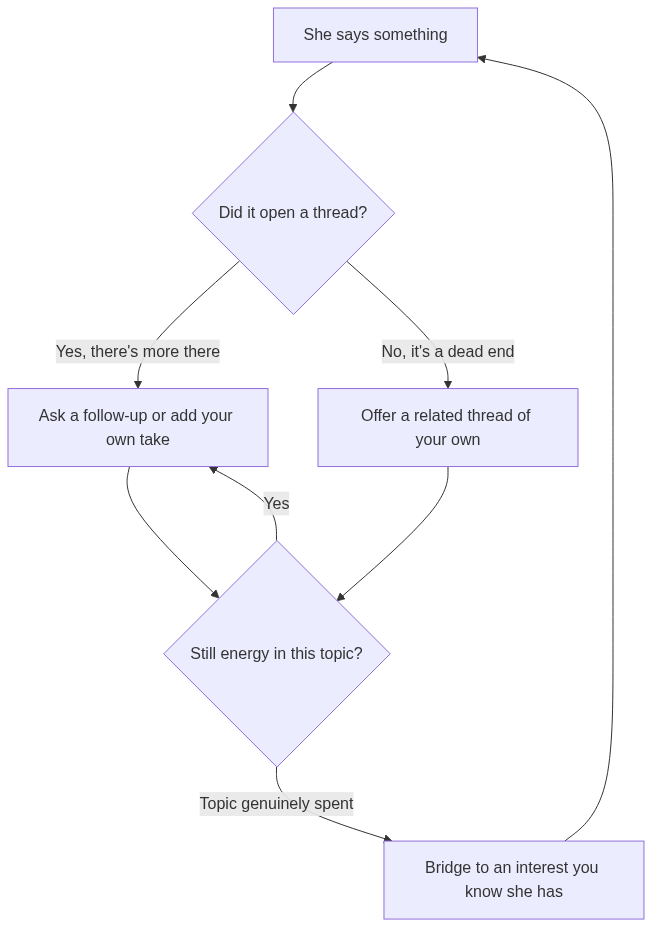
Walk that loop and you can see why you never actually run dry. Every answer she gives is raw material for the next question. The conversation only dies when you stop pulling on the thread and reach for the checklist instead. The threading approach also lines up with how closeness gets built in the first place. Arthur Aron's famous closeness study found that pairs who did escalating, reciprocal self-disclosure felt far closer than pairs who made small talk for the same 45 minutes. Going deeper on one thing beats going wider on ten.

The playbook: how to keep a conversation going
Enough theory. Here is the actual move set, in order of how often you'll use it.
1. Ask the follow-up before the new question. Whatever she just said, there is always a "why," a "how," or a "what was that like" hiding in it. Spend that first. The new topic can wait. You'll be shocked how rarely you need it.
2. Make statements, not just questions. A conversation that's all questions becomes an interrogation, and that's its own way to run dry. React. Have an opinion. "Lisbon, I've heard the food there is unreal" gives her something to push against, which is easier to answer than a cold question. Trade off: one statement, one question, repeat.
3. Listen for the thread, not the gap. Your job while she's talking is not to prepare your next line. It's to catch the one detail in what she said that has more behind it. There's almost always one. The detail she lingers on, the thing she said with a little extra energy, that's the thread.
4. Go back, not forward. When a topic does end, you don't have to find a new one. Reach back to something she said ten minutes ago. "Wait, you mentioned you used to compete, I want to come back to that." It shows you were listening the whole time, which is the rarest and most attractive thing you can do.
5. Use the room. You are not trapped inside your own head for material. The bar, the drink, the song playing, the thing on the wall. "That's the third time they've played this song" is a perfectly good thing to say and it resets the energy.
If your version of keeping things going leans on humor, the same thread logic applies to jokes. Callback humor, riffing on something she said earlier, lands harder than a canned line, and we go deep on that in how to be funny in DMs.
Advanced: walk in with her interests pre-loaded
Threading keeps a conversation alive once it's started. But the strongest position is walking in already knowing where the good threads are.
This is where most advice quietly fails you. "Just be curious" is true and useless if you're sitting across from a near-stranger with nothing to be curious about yet. The fix isn't to memorize a script. It's to show up knowing two or three things she actually cares about, so that when the conversation needs somewhere to go, you have a real direction instead of a cold "so, hobbies?"
Dale Carnegie figured this out in 1936, and it has not aged a day:
You can make more friends in two months by becoming interested in other people than you can in two years by trying to get other people interested in you.
The catch is that genuine interest takes homework, and Instagram makes the homework easy. Her profile is a map of her threads. The races she runs, the trips she posts, the cafe she's always tagging, the dog, the band, the side project. Each of those is a thread you can open without fishing. You're not memorizing facts to recite at her. You're loading two or three directions you can steer toward when a topic runs out, so you always have somewhere genuine to go.
This is the entire reason Piercr exists. It reads an Instagram profile in about 90 seconds — her posts and the accounts she follows — and hands you the specific things worth talking about, so you walk into the date or the DM already knowing which threads are live. Install Piercr free and pull a profile read before your next date.
A quick warning: pre-loading is for direction, not for performance. Don't recite her bio back at her or reference a post she'll be weirded out you found. The point is to know roughly what she's into so the conversation has somewhere natural to flow, not to prove you did surveillance. If you want the line between thoughtful and creepy spelled out, signs she likes you on Instagram covers how to read interest without overreaching.
What to say when you run out of things to talk about over text
Text is where conversations die quietest, because there's no body language to carry you and no bar to point at. The dry-up is usually one of two things: you both defaulted to status updates ("how was your day" / "good, you?"), or someone gave a closed answer and nobody reopened it.

The thread logic still works, it just needs more deliberate effort over text.
- Reopen an old thread instead of starting a new one. "Wait, did you ever end up going to that thing on Saturday?" beats "wyd." It proves you remember, which over text is most of the battle.
- Send a statement she can react to. A thought, an opinion, something you saw that reminded you of her. Reactions are easier to reply to than questions, and they don't feel like a quiz.
- Stop sending status checks. "How's your day going" is the small-talk machine in text form, and it runs out of road instantly. Trade it for anything specific.
- Know when to move it off text. If you're three days into a good thread, the move isn't a better text. It's "this is a tangent for drinks, you free Thursday?"
A dying text thread is rarely about a topic shortage. It's about both people coasting on autopilot. For the full breakdown of pace, timing, and what actually gets replies, how to text a girl you like is the deeper guide, and if she went quiet, how to start a conversation on Instagram covers reopening cold.
Real examples: a dying conversation vs a flowing one
Make it concrete. Same opening line, two different guys.
The checklist guy:
Her: "I actually just got back from a trip to Portugal."
Him: "Oh nice. Do you travel a lot?"
Her: "Not really, maybe once a year."
Him: "Cool. So what do you do for work?"
He had a door wide open and walked past it twice. Three exchanges in, he's already burned two topics and the energy is flat. He'll be out of material in five minutes and reaching for "so, any plans this weekend?"
The thread guy:
Her: "I actually just got back from a trip to Portugal."
Him: "No way. Was that a bucket-list thing or more of a spontaneous escape-the-country move?"
Her: "Ha, honestly a bit of both. Work was burning me out."
Him: "I get that. Did it actually work, or did you spend the whole time checking email on a beach?"
Same start. But he pulled the thread, and now they're talking about burnout, work, what she does to recover, none of which he had to plan. He's also made it personal fast, which is exactly the escalating self-disclosure Aron's research found builds closeness. He will not run out of things to say, because he isn't generating topics. He's following one.
The Plenty of Fish data backs the stakes here. Conversation is what she's actually grading, and small things move the needle hard. The same survey found 58% of singles say bad grammar is a bigger turnoff than bad sex. The talk is not the warm-up to the date. It is the date.
The bigger picture
The guys who never run out of things to say are not the ones with the best material. They're the ones who stopped trying to have material at all.
That's the shift. You're not the entertainment, responsible for keeping a list of topics alive. You're a curious person across the table from another person who is, almost certainly, more interesting than the safe questions you keep reaching for. The liking gap research says she probably likes you more than you think anyway, so the panic was never warranted. Drop the scoreboard. Follow what she gives you. Go deeper instead of wider, and walk in knowing roughly where the good threads are.
Do that and the silence stops being a threat. It becomes a place you choose to pause, not a hole you fall into.

Install Piercr free and let it tell you what she actually cares about before you sit down, so the only thing you have to do is listen.
FAQ
How do I never run out of things to say on a date?
Stop trying to stock up on topics and start following threads instead. Whatever she says, ask the follow-up before reaching for a new subject, and react with your own take rather than only firing questions. One good thread, pulled deep, lasts longer than ten topics skimmed. Walking in already knowing two or three of her real interests gives you somewhere to steer when a topic does end.
What do you say when you run out of things to talk about?
Go back instead of forward. Reach for something she mentioned earlier ("you said you used to compete, tell me about that") rather than scrambling for a brand-new topic. You can also use the room, the song, the drink, anything in front of you, or make a statement she can react to. The next thing to say is almost always hiding in something she already told you.
Why does the conversation keep dying with a girl I like?
Usually because you're treating it like a checklist and changing topics too fast. You ask a question, half-listen because you're loading the next one, then jump to something new instead of going deeper on her answer. That burns through material and reads as low interest. Slow down, follow the thread she opened, and the conversation stops stalling.
How do I keep a text conversation going without being annoying?
Reopen old threads instead of sending "wyd" or "how's your day." Reference something specific she told you earlier, send a thought she can react to, and cut the status-check messages that go nowhere. When a thread has real momentum, move it off text and suggest meeting up rather than texting it to death.
Is it weird to look up her interests before a date?
Only if you use it to perform. Knowing roughly what she's into so the conversation has somewhere natural to go is just preparation, the same thing a good interviewer does. Reciting her posts back at her or referencing something she'll be unsettled you found is where it gets weird. Use it for direction, not for show.