
Original research
Instagram Bios: 44% of Them Say the Same Two Things
- Sample
- 1,707 Instagram bios, broken into 2,184 discrete signals
- Collected
- October 2025 to January 2026
- Method
- Each bio parsed against a fixed 21-category taxonomy, one signal per claim about the person
- Main limitation
- Not a random sample of Instagram. 88.2% of profiles were predicted female and none were predicted male, and the corpus skews to the UK.
Key takeaways
- I broke 1,707 Instagram bios into 2,184 individual signals using a 21-category taxonomy. The average bio produced 1.28 of them.
- 31.4% of bios produced no extractable signal at all, and another 30.9% produced exactly one. Six bios in ten give you one thing or nothing.
- Location and Profession are 44% of everything bios say, and they are the two least distinguishing categories measured. Job and city describe a demographic, not a person.
- Emoji strings and quotes are the opposite: 214 of 216 emoji strings and 74 of 75 quotes were unique to one person. Maximum signal, no category.
- Private accounts wrote bios 37% shorter and were 24% more likely to say nothing at all.
- Books appeared 7 times in 1,707 bios. Nobody is telling you what they read.
In This Post
- How I measured 1,707 Instagram bios
- Most Instagram bios tell you almost nothing
- What is actually inside an Instagram bio
- The most common thing in a bio is the least useful
- Emoji strings and quotes behave like fingerprints
- A longer bio really does tell you more
- Private accounts say less in the one place you can still read
- What she does versus what she likes
- Which signals turn up together
- What to do if you are reading a bio
- What to do if you are writing one
- What this study cannot tell you
- FAQ
How I measured 1,707 Instagram bios
We hold a database of 48,877 Instagram profiles collected between October 2025 and January 2026. Of those, 1,707 had their bio stored and parsed. Each bio was passed through a fixed 21-category taxonomy that splits a line of text into discrete signals, where a signal is one claim about the person: a place, a job, a sport, a pet, a star sign, a quote.
That produced 2,184 signals across 1,172 profiles. The other 536 bios produced none.
Every number below is a count over that corpus, not an estimate and not a sample of a sample. Where a figure rests on a subset, the subset size is next to it.
The honest part first, because it changes how you should read everything after it. This is not a random sample of Instagram. These are profiles our users looked up, which means they skew hard: 88.2% were predicted female, and the corpus contains zero profiles predicted male. They also skew geographically, with the UK accounting for 218 of the 465 named location signals. And the signals were extracted by a language model, so "produced no signal" means the extractor found nothing it could categorise, which is not the same as a bio being empty.
What survives that skew is the structural stuff: how much a bio carries, how repeatable each category is, how length predicts readability. What does not survive is any claim about what people in general are into. I have kept those separate throughout.
Most Instagram bios tell you almost nothing
The first result is the one that reframes the rest. The average bio in the corpus produced 1.28 signals.
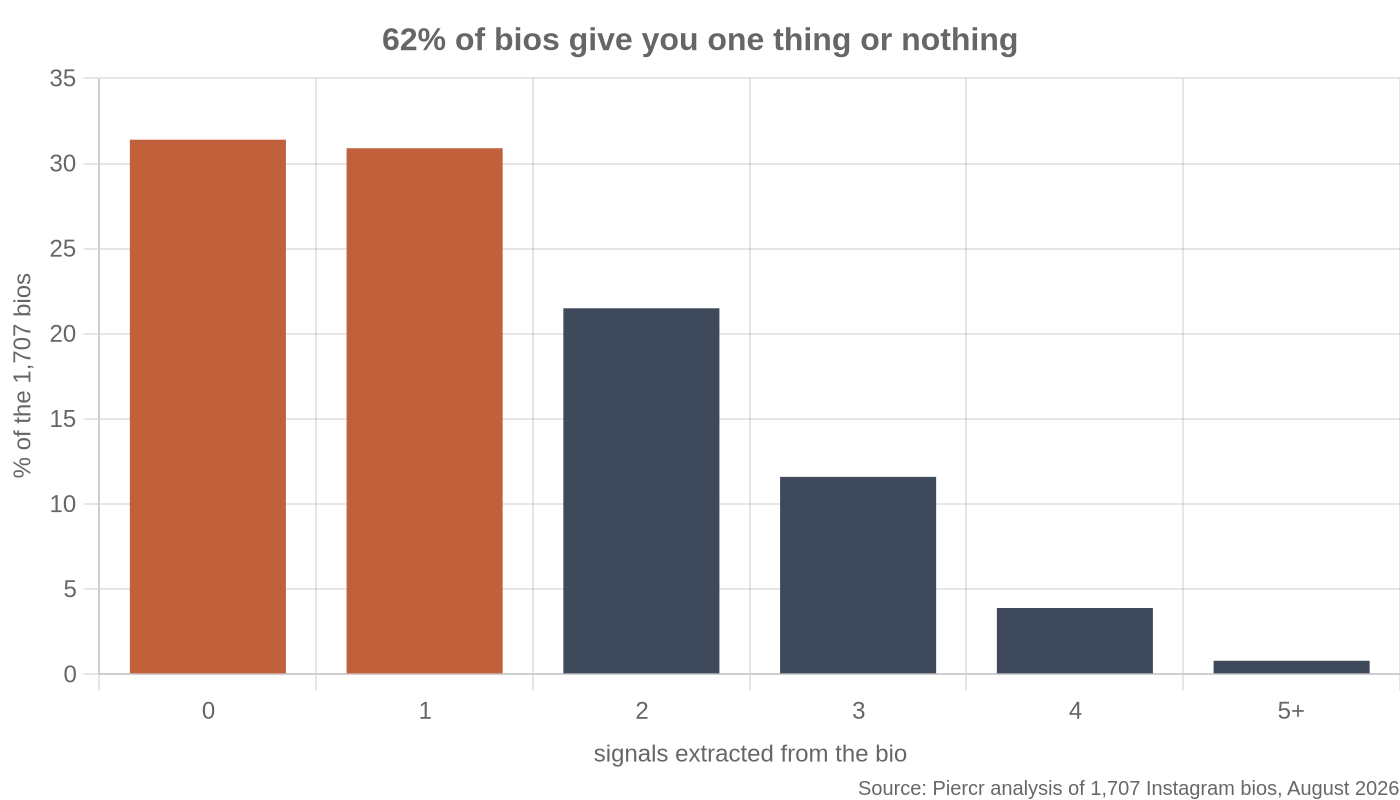
| Signals extracted | Bios | Share | Running total |
|---|---|---|---|
| 0 | 536 | 31.4% | 31.4% |
| 1 | 528 | 30.9% | 62.3% |
| 2 | 367 | 21.5% | 83.8% |
| 3 | 198 | 11.6% | 95.4% |
| 4 | 66 | 3.9% | 99.3% |
| 5 to 7 | 12 | 0.7% | 100% |
Six bios in ten give you one thing or nothing. The bio is not a profile. It is a caption.
The mechanics back that up. Only 2.4% of bios contained a link. 29.1% contained an @mention, usually pointing at another account rather than saying anything. 65.7% contained at least one emoji, which is the single most common thing in an Instagram bio and also the hardest to read.
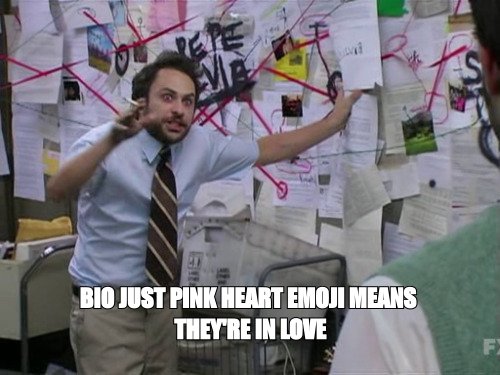
Some of the silent bios in the corpus, reproduced by shape rather than verbatim: a single heart emoji. A star and an age. One tagged account and nothing else. A four-word fragment of a song lyric. You can stare at any of these for ten minutes and leave knowing nothing.
What is actually inside an Instagram bio
When a bio does say something, here is what it says. This is all 2,184 signals, sorted by volume.
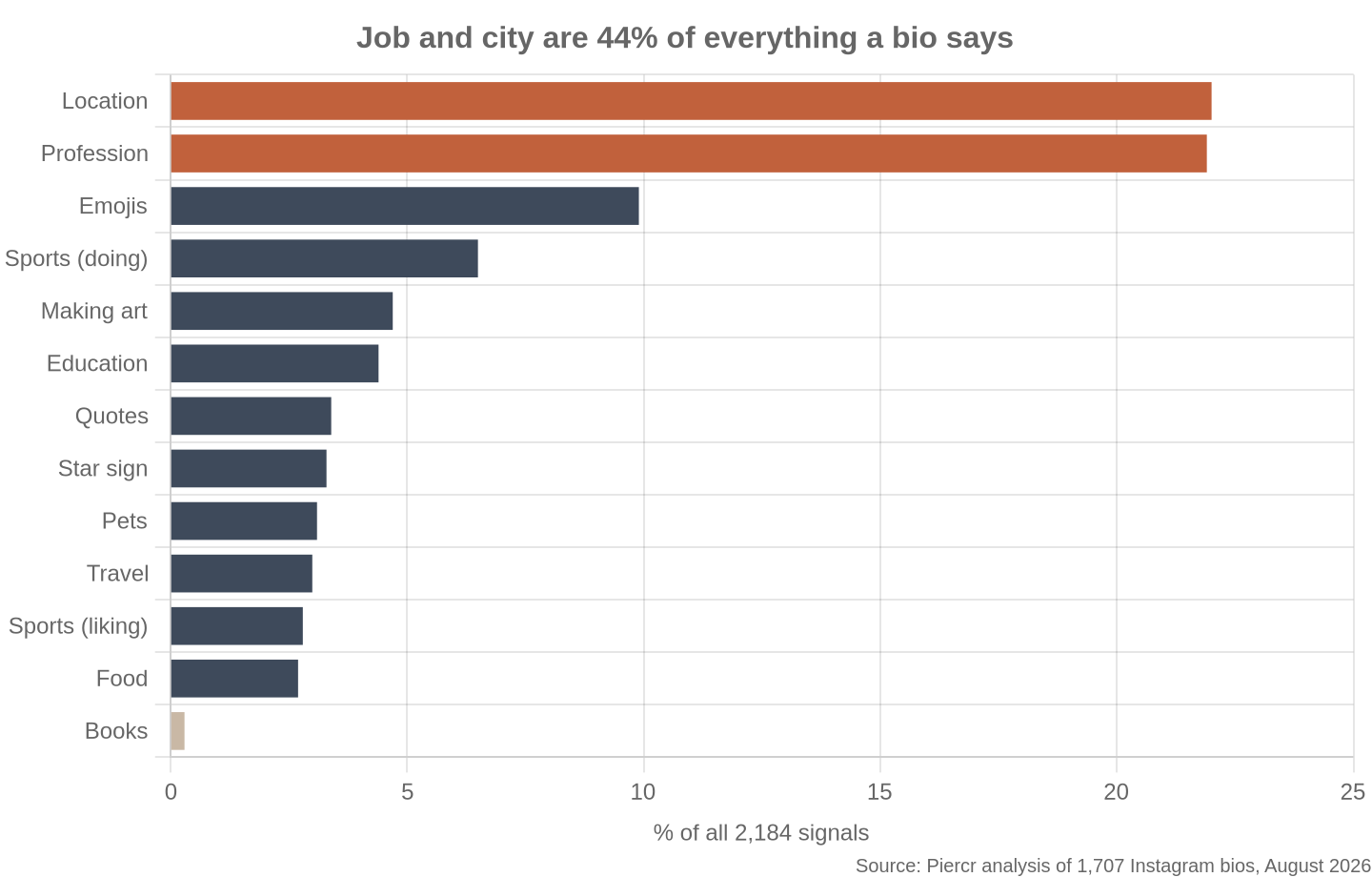
| Category | Signals | Share | Distinct values |
|---|---|---|---|
| Location | 481 | 22.0% | 73 |
| Profession | 479 | 21.9% | 90 |
| Emojis | 216 | 9.9% | 214 |
| Sports Performance | 143 | 6.5% | 53 |
| Making Art | 103 | 4.7% | 43 |
| Education | 97 | 4.4% | 62 |
| Quotes | 75 | 3.4% | 74 |
| Star Sign | 71 | 3.3% | 12 |
| Pets | 68 | 3.1% | 8 |
| Travel | 66 | 3.0% | 29 |
| Sports | 62 | 2.8% | 21 |
| Food | 60 | 2.7% | 41 |
| Design | 58 | 2.7% | 17 |
| Music Performance | 48 | 2.2% | 19 |
| Music | 39 | 1.8% | 13 |
| Language | 32 | 1.5% | 15 |
| Nature | 31 | 1.4% | 18 |
| Art | 20 | 0.9% | 16 |
| Movies / TV | 16 | 0.7% | 9 |
| Vehicles | 12 | 0.5% | 6 |
| Books | 7 | 0.3% | 2 |
Two categories carry 44% of the load. Everything else fights over the rest.
And look at the bottom of that table. Movies and TV, 16 signals. Vehicles, 12. Books, 7 signals across 1,707 bios. The categories that would give you something to talk about are the ones nobody fills in.
What the top values look like
Within Location: the UK 218, London 37, Lithuania 28, the USA 22. Within Profession: Business 101, Healthcare 90, Design 54, Entertainment 24, Beauty 19. Within Pets, dogs beat cats 35 to 22. Star signs came out almost perfectly even across all twelve, with no sign appearing more than 8 times. These specific rankings are the part most affected by the sample skew described above, so treat them as descriptive of this corpus rather than of Instagram.
The most common thing in a bio is the least useful
This is the finding worth the study.
Count how often a category appears. Then count how many distinct values it takes. Divide one by the other and you get how distinguishing the category is: whether learning it tells you about a person or about a demographic.
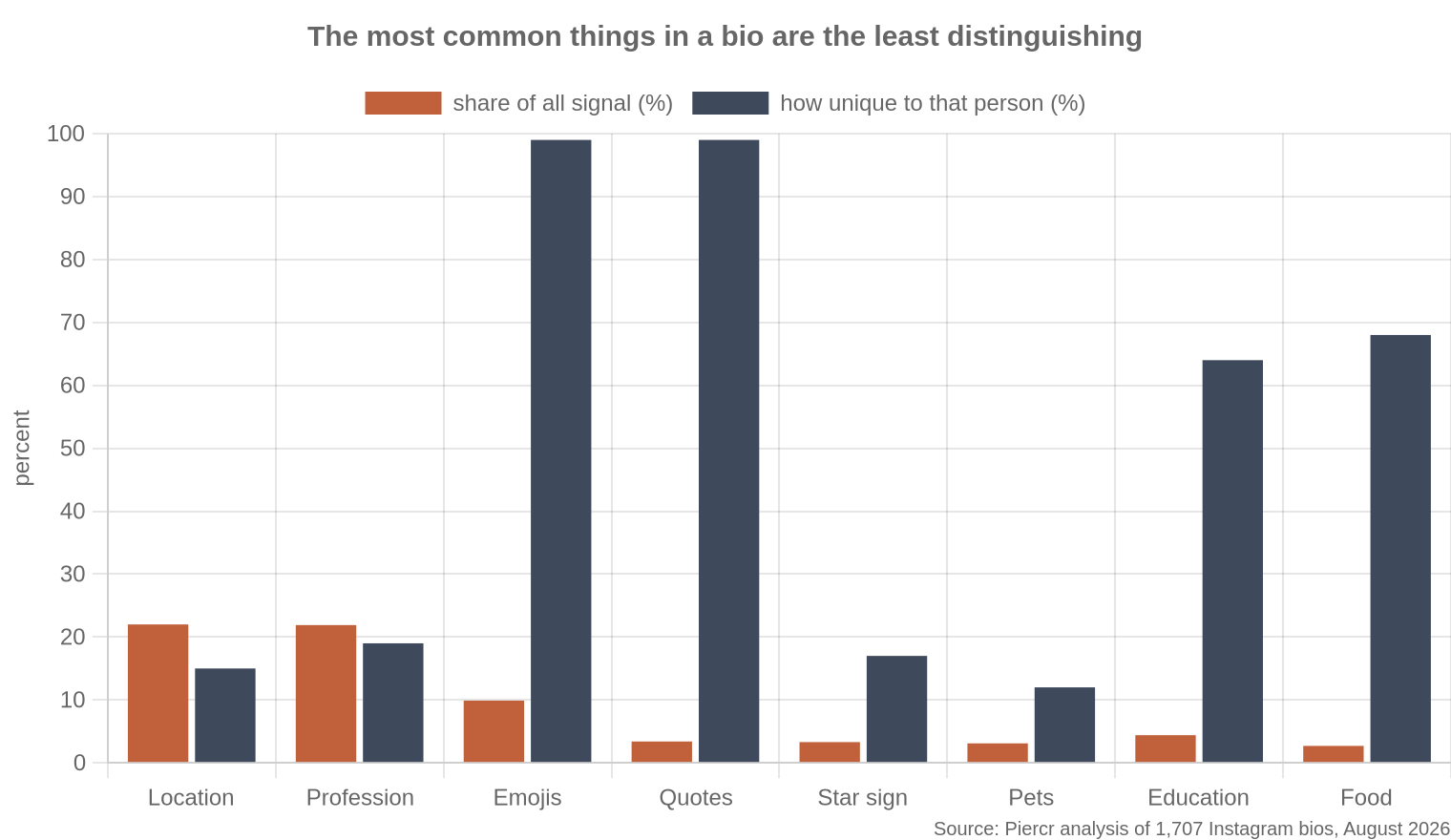
| Category | Share of all signal | Distinct values | How unique to one person |
|---|---|---|---|
| Location | 22.0% | 73 | 15% |
| Profession | 21.9% | 90 | 19% |
| Pets | 3.1% | 8 | 12% |
| Star Sign | 3.3% | 12 | 17% |
| Design | 2.7% | 17 | 29% |
| Education | 4.4% | 62 | 64% |
| Food | 2.7% | 41 | 68% |
| Art | 0.9% | 16 | 80% |
| Emojis | 9.9% | 214 | 99% |
| Quotes | 3.4% | 74 | 99% |
The relationship runs backwards. The two categories people fill in most are the two that separate them from other people least. 218 women in this corpus said "UK". 101 said some version of "business". Knowing either one narrows the field by almost nothing.
Think about what that means for the thing everyone does, which is scan a bio for an opener. You scan it, you find a job and a city, and you have found the two facts least likely to be about her specifically.
Emoji strings and quotes behave like fingerprints
The other end of that table is stranger and more interesting.
216 emoji strings produced 214 distinct values. Two collisions in the whole set. 75 quotes produced 74 distinct values, and the single repeat was a Bible verse.
So the most personal content in a bio is also the least categorisable. An emoji run is dense with meaning and impossible to aggregate. It is closer to a signature than to a sentence, which is exactly why it defeats the scan-for-a-topic approach and exactly why it is worth reading properly.
This cuts both ways. If you cannot decode it, do not pretend you can. Three fruit emoji and a flag are not a personality profile, and guessing at them out loud is how a first message goes wrong. There is a longer version of that argument in what her Instagram says about her.
A longer bio really does tell you more
Bio length is the single cleanest predictor in the dataset, and it moves in a straight line.
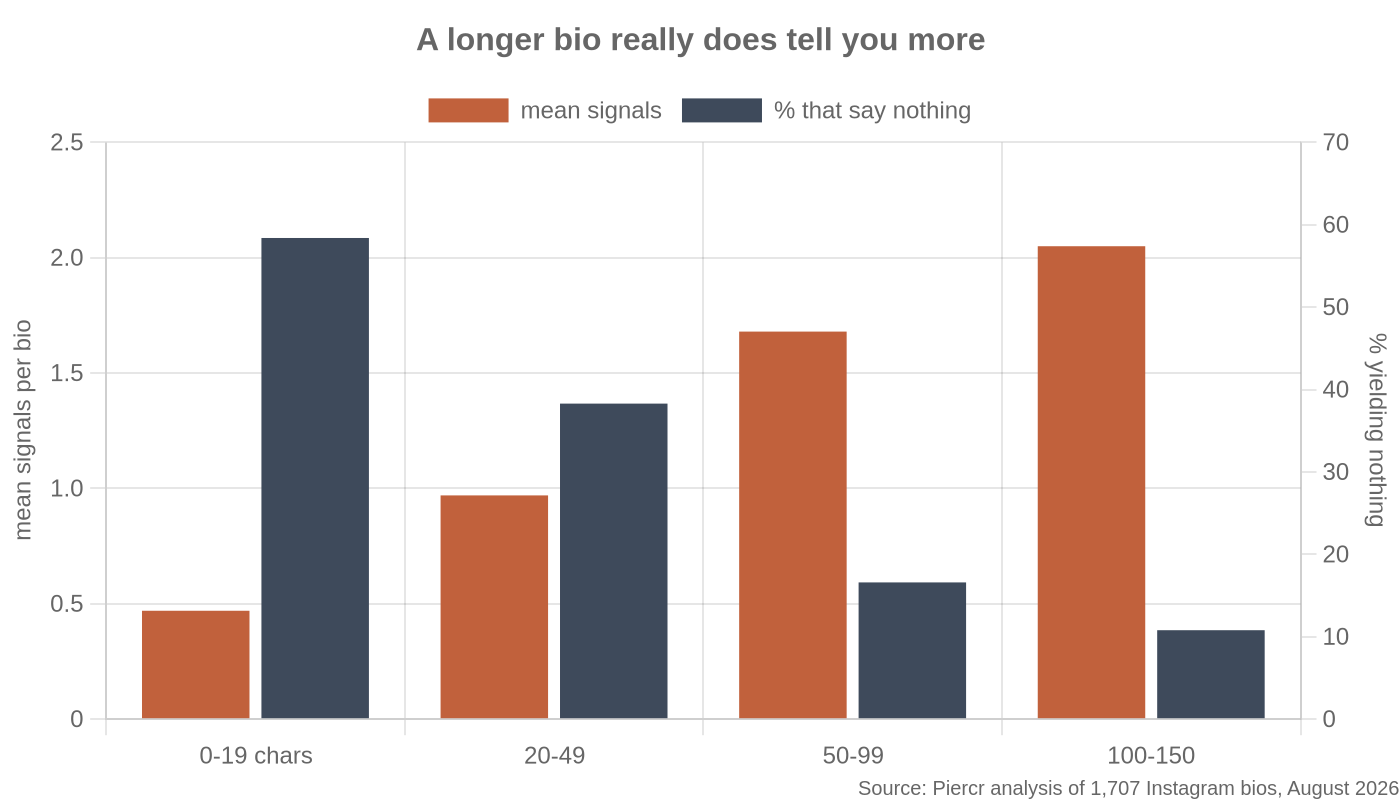
| Bio length | Bios | Mean signals | Produced nothing |
|---|---|---|---|
| 0 to 19 characters | 449 | 0.47 | 58.4% |
| 20 to 49 | 413 | 0.97 | 38.3% |
| 50 to 99 | 428 | 1.68 | 16.6% |
| 100 to 150 | 417 | 2.05 | 10.8% |
Four times the signal from the longest bucket compared with the shortest. A bio under 20 characters is a coin flip weighted against you. A bio that uses most of the 150 available characters fails to say anything only one time in nine.
This is useful before you have read a word. Bio length is visible instantly and tells you whether reading it carefully is worth the time.
Private accounts say less in the one place you can still read
A private account still shows its bio. That makes the bio the only text you get, and it turns out to be the thinnest text you get.
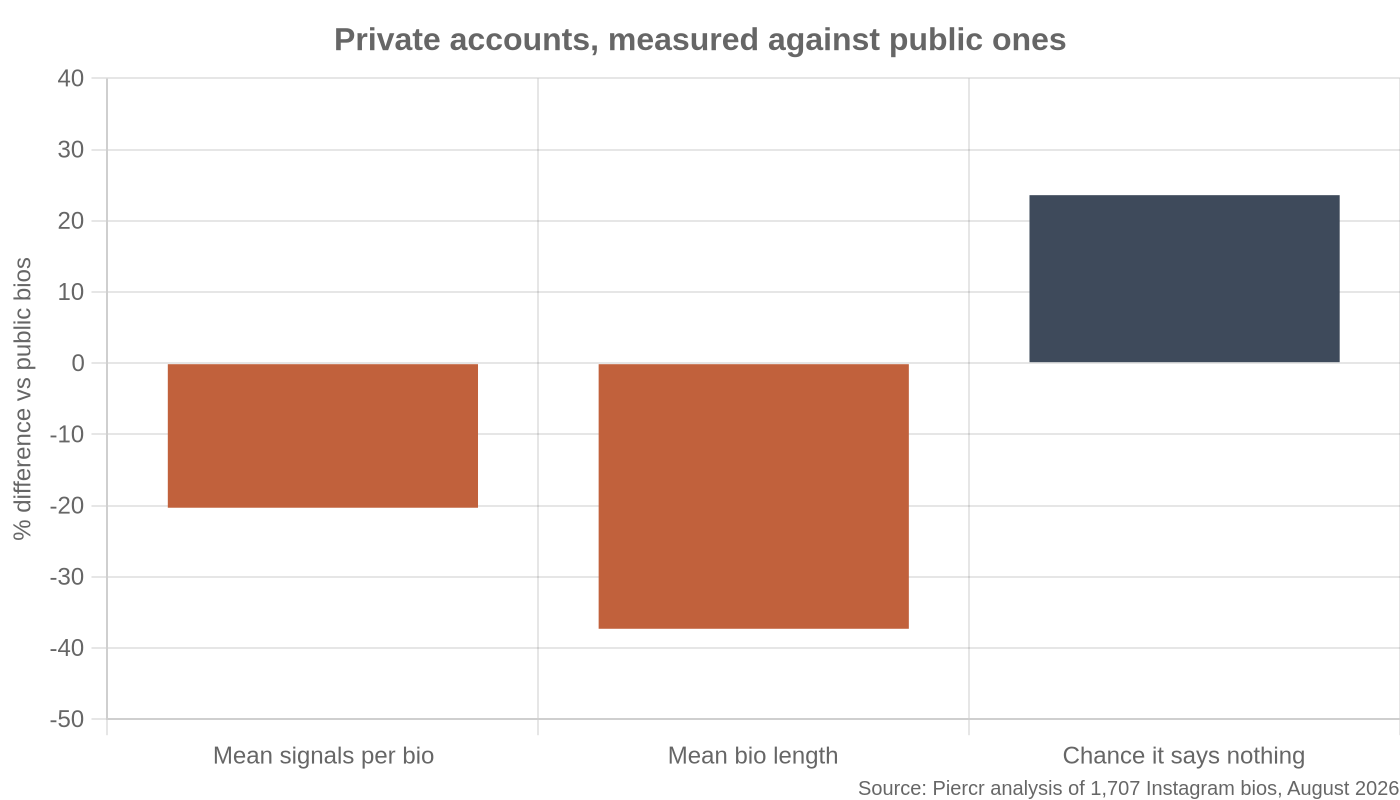
| Measure | Public (n=829) | Private (n=878) | Difference |
|---|---|---|---|
| Mean signals per bio | 1.43 | 1.14 | -20% |
| Mean bio length | 75 chars | 47 chars | -37% |
| Produced no signal | 28.0% | 34.6% | +24% more likely |
Both groups came through the same collection pipeline, so this compares like with like. Private accounts write shorter bios and say less in them. The door is shut and the nameplate is emptier.
There is a reasonable reading of this that has nothing to do with secrecy: if your account is private, the bio is not doing marketing work, so there is less reason to fill it. Either way the practical effect is the same. The profiles you can see least are the profiles whose bios tell you least.
What she does versus what she likes
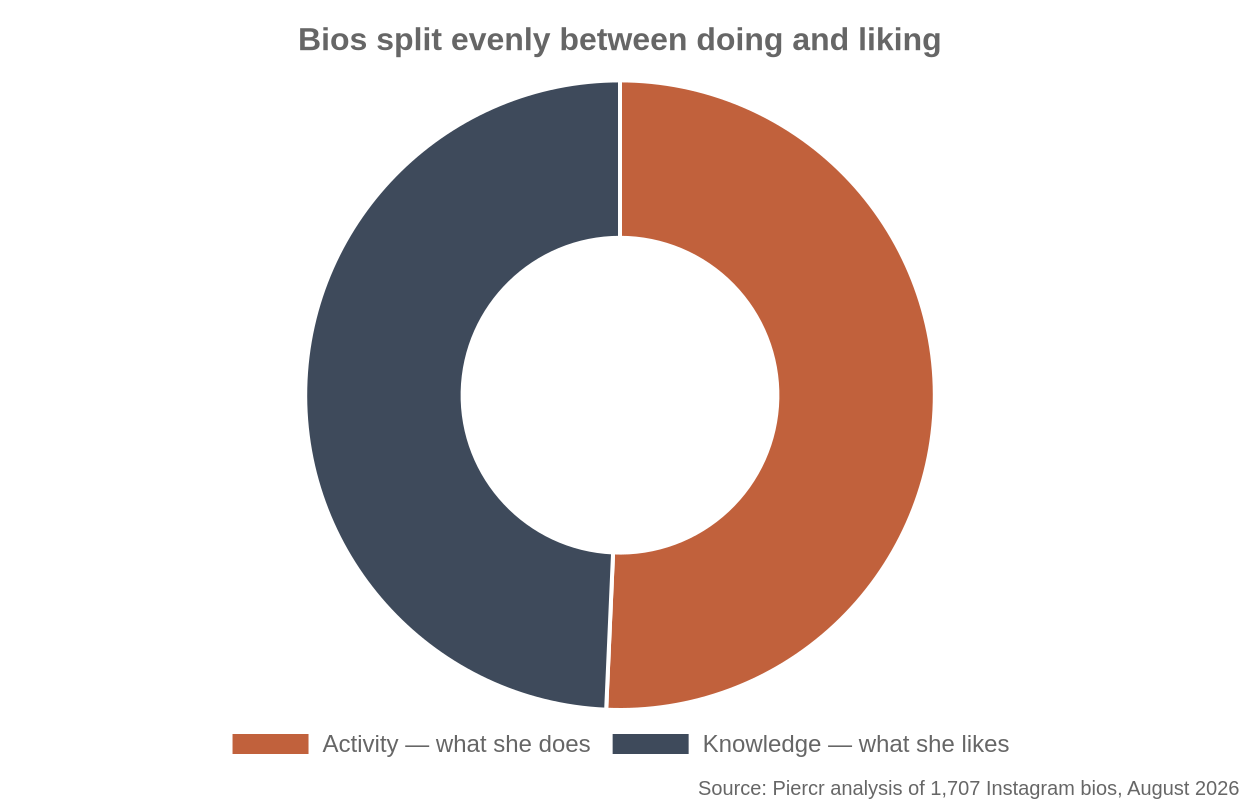
The taxonomy tags every category as either Knowledge, meaning something the person likes or knows about, or Activity, meaning something they actually do. Across 2,184 signals the split is almost exactly even.
| Type | Signals | Share |
|---|---|---|
| Activity, what she does | 1,107 | 50.7% |
| Knowledge, what she likes | 1,077 | 49.3% |
I expected doing to win comfortably, because a bio is a place people list credentials. It did win, by 30 signals out of 2,184, which is a rounding error. Bios are half CV and half taste, in almost exact balance.
Which signals turn up together
Signals do not appear at random. Of the 1,172 profiles with at least one signal, here are the pairs that co-occurred most.
| Pair | Profiles |
|---|---|
| Location + Profession | 200 |
| Profession + Sports Performance | 73 |
| Education + Profession | 68 |
| Emojis + Location | 67 |
| Making Art + Profession | 53 |
| Emojis + Profession | 48 |
| Design + Profession | 43 |
| Location + Travel | 43 |
| Location + Sports Performance | 35 |
| Location + Making Art | 32 |
Profession appears in six of the top ten pairings. And the most common informative bio in the entire corpus is literally a job and a city, 200 profiles of it.
What to do if you are reading a bio
The data points at a fairly blunt conclusion. The bio is a starting point with a low ceiling, and most people treat it as the whole document.
| Reading the bio like most people do | Reading it like the data suggests |
|---|---|
| Scan for any fact, open with the first one found | Check the length first. Under 20 characters, expect nothing and move on |
| Treat job and city as personal details | Treat job and city as demographics, because 44% of bios have them |
| Skip the emoji run as decoration | Read the emoji run as the most individual thing there, and do not guess at it out loud |
| Assume a private account is hiding something | Expect a private bio to be 37% shorter and more often empty |
| Give up when the bio is blank | Treat a blank bio as information about the bio, not about the person |
A third of the time the bio will give you nothing, and that is not a failure of attention. It is the base rate. The rest of the profile, meaning what she posts and what she follows, is where the specific material lives, which is the argument made at more length in how to tell what a girl is into.
When you do find something usable, the move is to ask about it rather than to compliment it. Questions to ask your crush covers which ones actually get answered, and how to start a conversation on Instagram covers the opening itself.
Opening from a bio, badly and well
location is in 22% of bios and separates nobody. the sport is the part that is actually hers
naming the thing you cannot decode beats pretending you decoded it
What to do if you are writing one
The same numbers read from the other side are a fairly direct set of instructions, and most bio advice gets this backwards by telling you to be concise.
Writing a bio that actually says something
- Use the length. Bios in the 100 to 150 character band failed to say anything only 10.8% of the time, against 58.4% for the shortest.
- Cut one of job or city. Together they are 44% of all bios, so leading with both puts you in the largest possible crowd.
- Name one specific thing you actually do. Sports Performance and Making Art were 11% of signals combined and both carry real information.
- Say what you read or watch. Books appeared 7 times in 1,707 bios, so a single title makes you unusual immediately.
- Keep the emoji run if you like it, but do not let it be the only content. It is unique to you and unreadable to everyone else.
- Skip the star sign unless you mean it. Twelve values across the whole population is close to no information.
That is the whole trick. The categories nobody fills in are the ones with room in them.
What this study cannot tell you
A study that hides its limits is marketing. Here are this one's, in order of how much they matter.
Four limits worth knowing
1. The corpus contains zero profiles predicted male, and 88.2% predicted female. Nothing here describes men's bios, and no comparison between genders is possible. 2. These are profiles our users chose to look up, not a random draw from Instagram, so the population is people someone was already interested in. 3. The UK is 218 of 465 named location signals, so category rankings reflect a specific geography. Padel beating football 28 to 5 is a social graph, not a fact about sport. 4. Signals were extracted by a language model, so a bio producing no signal means the extractor found nothing categorisable, not that the bio was empty.
The structural findings hold up better than the content ones, and that is the distinction I would hold on to. How much signal a bio carries, how repeatable a category is, how length predicts readability: those are properties of the format and they would very likely replicate elsewhere. Which sports and which cities show up: that is this corpus, and it would not.
A cleaner version of this study is a random or stratified sample across both genders and several countries. That is work we have not done yet, and I would rather say so than dress this up as something it is not.
FAQ
What is the average Instagram bio length?
In this corpus the median was 48 characters, against an Instagram limit of 150. Half of all bios came in under 50 characters and 52.4% were a single line. The 100 to 150 character band was the only one where the bio reliably said something.
What do most people put in their Instagram bio?
A job and a city, more than anything else. Profession and Location were 22% and 21.9% of all extracted signals respectively, and 200 profiles carried exactly that pairing. Emoji were present in 65.7% of bios, though as content rather than as a fact about the person.
Do Instagram bios actually tell you anything useful?
Sometimes, and less often than people assume. 31.4% produced no extractable signal and another 30.9% produced exactly one, so roughly six in ten bios give you a single fact or nothing. The useful material is disproportionately in the rarer categories.
Can you see the bio of a private Instagram account?
Yes. Name, username, profile picture and bio stay visible on a private account. Posts, followers and following do not, which also rules out seeing who she recently followed. In this corpus private bios were 37% shorter and 24% more likely to produce no signal, so the one thing you can read is also the thinnest.
What makes a good Instagram bio?
By these numbers, one that uses the available length and names something specific rather than something demographic. Bios in the longest band failed to say anything only 10.8% of the time. The categories with the most room in them are the ones almost nobody uses, with books at 7 appearances across 1,707 bios.
How to cite this study
The data is ours and the numbers are free to use under CC BY 4.0 — reuse them anywhere, including commercially, as long as you credit the source. If you quote a figure, please link back so a reader can check the method and the limits for themselves.
Zukevicius, A. (2026). Instagram Bios: 44% of Them Say the Same Two Things. Piercr. 1,707 Instagram bios parsed into 2,184 signals, collected October 2025 to January 2026. https://www.piercr.com/blog/instagram-bio-signals
The full aggregate dataset is published as machine-readable JSON: instagram-bio-signals.json. It carries every table below plus the category breakdown, the length bands, the private/public split and the top twenty co-occurring pairs.
What it deliberately does not contain is any bio text, username, quote or emoji string. The underlying corpus is 1,707 people's own words, and publishing it would be a far worse thing than any statistic is worth. Counts carry the finding without carrying the person.
The headline figures, in the form most people will want them:
| Figure | Value | Base |
|---|---|---|
| Bios producing no extractable signal | 31.4% | 1,707 bios |
| Bios producing one signal or none | 62.3% | 1,707 bios |
| Mean signals per bio | 1.28 | 1,707 bios |
| Share of all signal that is Location or Profession | 43.9% | 2,184 signals |
| Emoji strings unique to one person | 214 of 216 | 216 emoji signals |
| Quotes unique to one person | 74 of 75 | 75 quote signals |
| Private bios producing no signal | 34.6% | 878 private bios |
| Public bios producing no signal | 28.0% | 829 public bios |
| Median bio length | 48 characters | 1,707 bios |