
How to Be More Confident With Women (DM Edition)
You don't have a confidence problem. You have a reps problem.
Somewhere along the way, the entire internet decided that confidence with women is a personality trait. (It isn't your looks holding you back either — see looks vs. confidence.) Something you either have or you don't. Like height or eye color. You're either the guy who walks up and talks to her, or you're the guy who watches from across the room and does nothing. And if you're the second guy, the advice is always the same: just be more confident. As if that sentence has ever helped anyone do anything.
Here's what nobody tells you. Confidence is not a trait. It is a skill. And like every skill, it is built through repetition in environments where the stakes are low enough to actually practice. You don't learn to drive on a highway. You learn in an empty parking lot. And DMs are the empty parking lot of dating.
Confidence with women is a skill built through progressive exposure and repeated low-stakes interactions, not a personality trait you either have or lack.
This post is not about being introverted. This is not about whether it's weird to message her. We covered that in is it weird to DM a girl. This is specifically about building confidence as a skill through progressive exposure, starting with the lowest-stakes interaction available to you in 2026: an Instagram DM.
Your Brain Is Sabotaging You (And Here's the Neuroscience)
Before we talk about what to do, you need to understand what's happening inside your skull when you hover over that send button.
In 2003, researchers at UCLA ran an fMRI study on social exclusion that changed how neuroscience thinks about rejection. It's one reason modern dating is brutal right now. They had participants play a virtual ball-tossing game while inside a brain scanner. When the other players stopped throwing the ball to the participant, the anterior cingulate cortex lit up. That's the same brain region that activates when you touch a hot stove. Social rejection and physical pain share neural circuitry. Your brain literally cannot tell the difference.
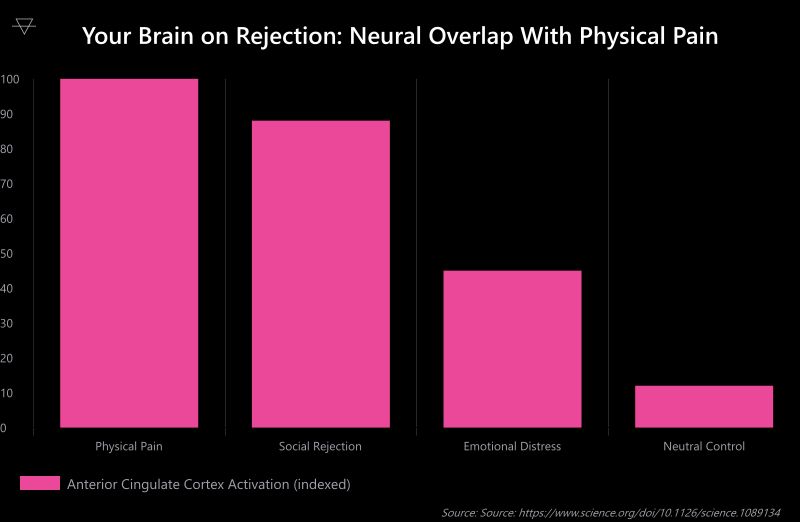
A follow-up study published in PNAS went further. They found that intense social rejection activates the secondary somatosensory cortex and the dorsal posterior insula, regions previously thought to be exclusive to physical pain processing. The overlap is not metaphorical. When someone says rejection "hurts," they are being neurologically accurate.
This is why you freeze. When you think about sending that DM, your brain runs a threat assessment. Possible rejection detected. The anterior cingulate cortex flags it. Your amygdala fires. Cortisol floods your system. Your heart rate increases. Your prefrontal cortex, the part responsible for rational decision-making, gets deprioritized because your nervous system just classified a text message as a survival threat.
Research shows rejection sensitivity increases cortisol reactivity, creating a feedback loop. The more you fear rejection, the stronger the stress response. The stronger the stress response, the more you avoid. The more you avoid, the more your brain confirms that the threat was real. You never sent the message. You never got rejected. But your brain logged it as a near-miss with danger and strengthened the avoidance circuit for next time.
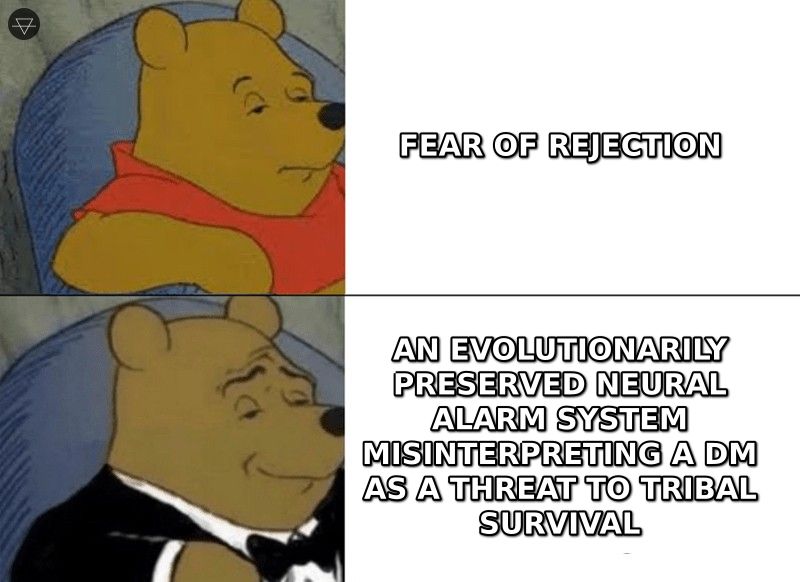
This is not a character flaw. This is leftover wiring from 200,000 years of tribal survival. Getting rejected by the group used to mean death. Your nervous system hasn't updated its threat model for the fact that the worst thing that happens when you DM a stranger on Instagram is literally nothing. She doesn't reply. You never find out she saw it. Life continues.
Why "Just Be Confident" Is Useless Advice
Every dating coach, every Reddit thread, every YouTube thumbnail says the same thing. Be confident. As if confidence is a switch you forgot to flip. The reason this advice fails is that it confuses the outcome with the process.
Albert Bandura's self-efficacy research demonstrated that confidence is not a fixed personality trait. It is a belief in your ability to execute specific behaviors, and that belief is built through four mechanisms:
1. Mastery experiences. You tried something. It worked. Your brain updated its model. This is the most powerful source of self-efficacy. You don't believe you can do something because someone told you to believe it. You believe it because you did it and survived.
2. Vicarious learning. You watched someone similar to you succeed. Your brain ran a simulation and concluded: if he can do it, maybe I can too. This is why success stories work. Not because they're motivating. Because they're evidence.
3. Verbal persuasion. Someone you respect told you that you could do it. This is the weakest source. Which is why "just be confident" from a stranger on the internet does approximately nothing.
4. Physiological state management. You learned to interpret your racing heart as excitement rather than terror. Reappraisal. Same sensation, different label, different behavior.
The dating industry skips straight to telling you to be confident (verbal persuasion, the weakest mechanism) and ignores the thing that actually builds it: mastery experiences. Repeated exposure to the thing you're afraid of, starting small and scaling up.
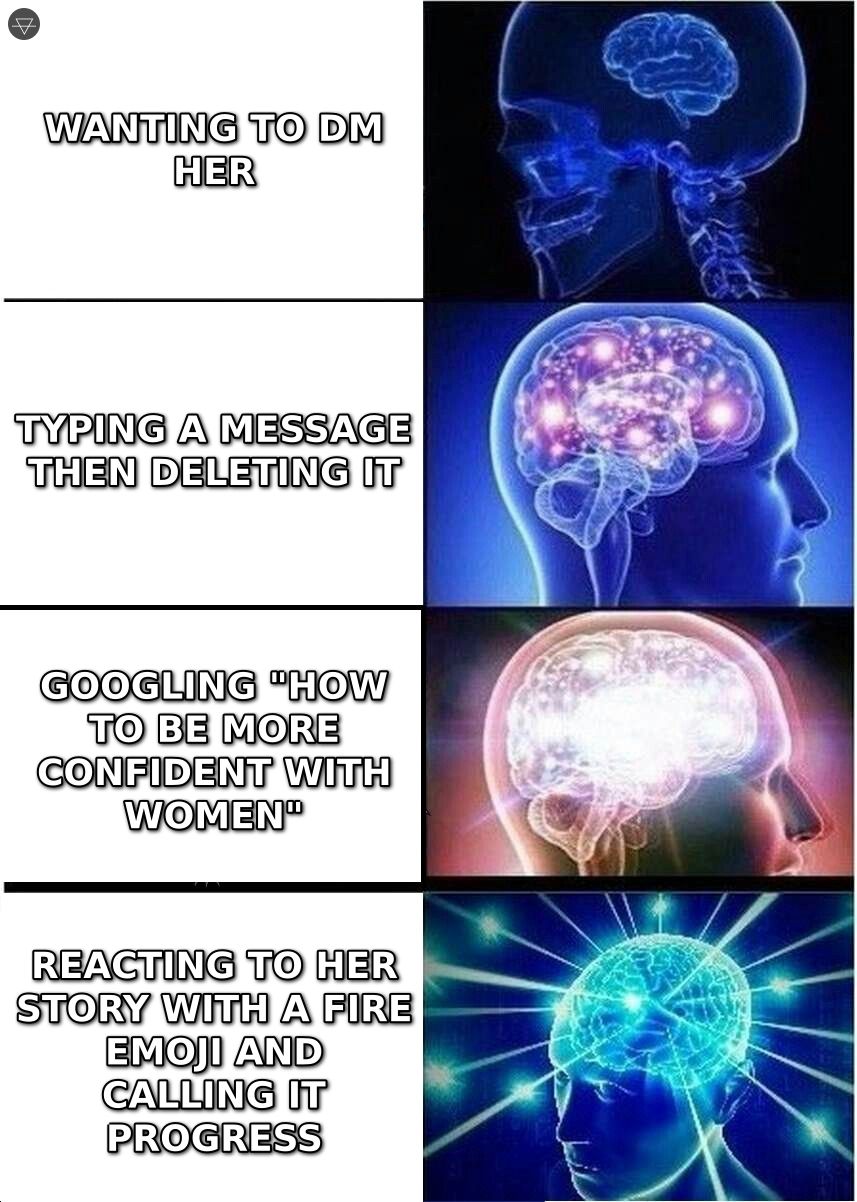
The Confidence Progression: Story Reactions to Cold DMs
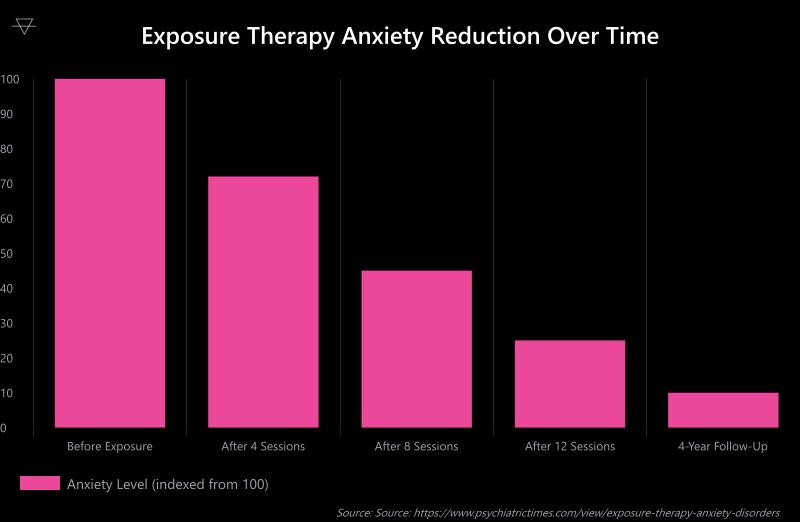
Exposure therapy is the most researched treatment for anxiety disorders. The principle is simple. You expose yourself to the feared stimulus in a controlled way, starting with the least threatening version and gradually increasing intensity. At each step, your brain learns that the predicted catastrophe doesn't happen. The threat model updates. The anxiety decreases.
At posttreatment follow-up after an average of four years, 90% of patients maintained significant reduction in fear, avoidance, and overall impairment. This is not some fragile improvement that evaporates when you stop trying. The neural pathways physically change.
Here is how you apply this to confidence with women. Not as a metaphor. As an actual protocol.
Level 1: Story Reactions (Zero Risk)
Tap the heart or fire emoji on her Instagram story. That's it. You are not writing anything. You are not exposing yourself to a conversation. You are pressing a button. She sees your name in her notifications for half a second. There is no rejection possible here. She cannot reject a reaction. She might not even notice it.
The point of Level 1 is not to get her attention. The point is to get YOU to take action. Your brain needs evidence that initiating contact with an attractive woman does not result in death. A story reaction provides that evidence with zero downside.
Do this 10 times across different profiles over two weeks. Not the same girl 10 times. That's a different problem entirely. Ten different women, one reaction each. By the end of two weeks, your brain has 10 data points confirming that reaching out didn't kill you. The threat model starts updating.
Level 2: Story Replies (Low Risk)
Now you're writing words. But the stakes are still minimal. You're replying to something she posted. The context is built in. You're not manufacturing a reason to talk to her. She gave you one.
Keep it short. Under 15 words. Reference something specific in the story. "That trail looks brutal, where is that?" or "Wait, that's the place on 4th, right? Their broth is unreal." No compliments on her appearance. No pickup lines. Just a human responding to content another human posted. That's all this is.
Story replies go to her primary inbox, not message requests. She's more likely to see it and more likely to respond. But even if she doesn't, the exercise was never about her response. It was about you pressing send. Every send rewires the circuit a little more. Harvard research shows people who ask questions are rated significantly more likable. You're not just practicing confidence. You're practicing a behavior that is empirically proven to make people like you more.
Do this 10 to 15 times over three weeks. Track your sends. Not your replies. Replies are a lagging indicator. Sends are the leading indicator of confidence.
Level 3: Cold DMs (Medium Risk)
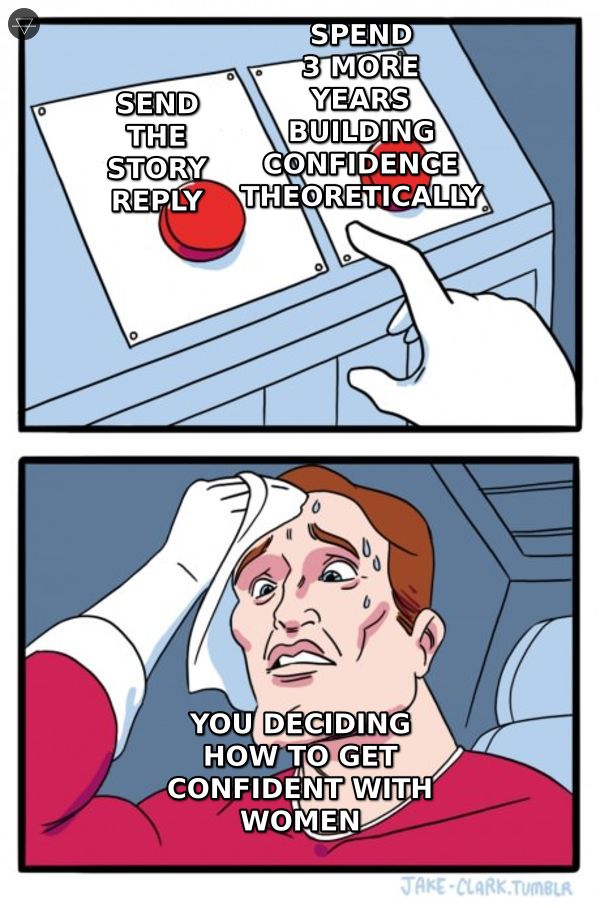
This is where most guys start. And that's why most guys fail. They skip the progression and jump straight into the deep end. A cold DM to a stranger with zero prior interaction, zero warmth, zero evidence that reaching out is safe. Of course the anxiety wins.
But if you've done Levels 1 and 2, you have 20 to 25 data points proving that contact doesn't equal catastrophe. Your nervous system has evidence. The cortisol response is weaker. The prefrontal cortex stays online longer. You can actually think while you're typing instead of panicking.
A cold DM is just a story reply without the story. Same principle. Reference something from her profile. Ask a question. Keep it specific. We covered the tactical details in how to DM a girl on Instagram and the opener frameworks in DM openers that get replies. The mechanics are there. What you've been missing is the neural readiness to execute them.
Level 4: Sustained Conversation (Higher Stakes)
She replied. Now what? This is where confidence compounds or collapses. If you've been building through the progression, you have the reps to stay calm. If you skipped to Level 4 on your first try, your cortisol is spiking because you have zero reference experiences telling your brain this is safe.
Match her energy. Don't write an essay in response to her three-word reply. Don't respond in 11 seconds. Don't be too available. The confidence you've built in Levels 1 through 3 gives you the ability to pause, think, and respond with intention instead of desperation. That's what confidence looks like in practice. Not the absence of anxiety. The ability to act despite it.
Why DMs Are the Perfect Training Ground
Every confidence-building framework requires a practice environment with reduced consequences. DMs provide that environment better than any alternative in 2026. Here's why.
No audience. When you approach a woman at a bar, everyone can see what happens. Her friends are watching. The people at the next table noticed. If she turns you away, the rejection has witnesses. In DMs, rejection is invisible. She doesn't reply. Nobody else on the planet knows you sent that message. The message request system means she can read and delete your message without you ever knowing she saw it. The worst case is literally nothing happening.
No time pressure. In person, you have seconds to respond. Silence is awkward. Pausing to think reads as uncertainty. In DMs, you can take four minutes to craft a response and it looks the same as taking four seconds. Text communication reduces cognitive load by 40 to 60% compared to voice conversations. Your brain can actually function instead of being hijacked by fight-or-flight.
Built-in context. Cold approaching a stranger in public means manufacturing a conversation from nothing. On Instagram, her profile is months of curated interests, opinions, humor, and personality. You never have to wonder what to say. She already told you what she cares about. You just have to reference it.
Scalable repetition. You can send 10 story replies in an evening. You cannot cold approach 10 women in an evening without burning out your entire nervous system. The low energy cost of DMs means you can accumulate reps faster than any in-person method. And reps are the only thing that builds confidence.
Drop her handle and Piercr reads her Instagram, then hands you a plain-English read on what she's into and how to open — so you spend less time overthinking the first message. You still send it. Try free.
The Numbers Behind Your Fear
Let's look at what's actually stopping you. Because it's probably not what you think.
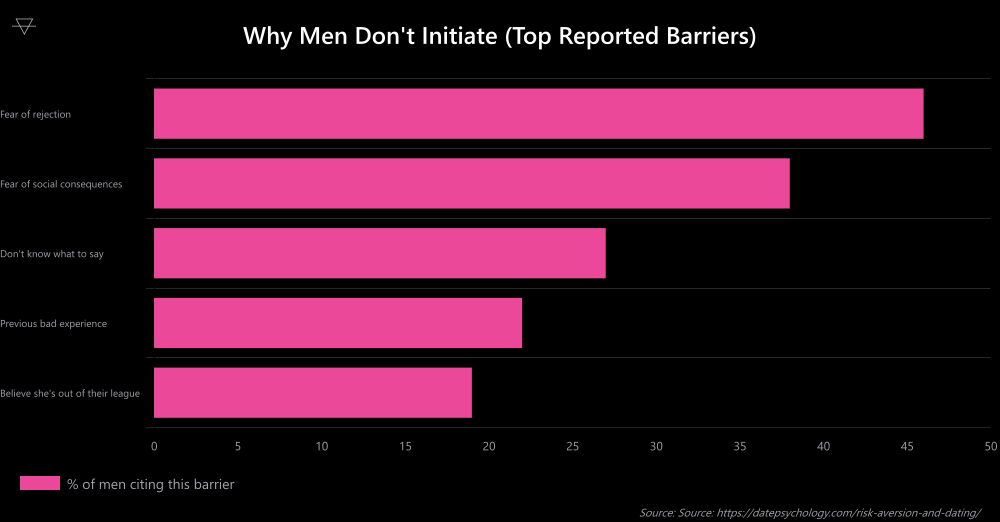
46% of men cite fear of rejection as the primary reason they don't initiate. But look at the second bar. 38% cite fear of social consequences. That's not the rejection itself. That's the fear of what happens AFTER the rejection. "What if she screenshots it?" "What if she tells her friends?" "What if people find out I got rejected?"
DMs eliminate the second fear entirely. There is no social consequence to a DM that gets ignored. She cannot publicly reject you because the interaction is private by design. And Instagram's message request system means non-followers can only send one text-only message. No images, no voice notes, no ability to spam. The platform was designed to make stranger-to-stranger contact low-stakes.
Almost half of young men have never approached a woman romantically in person. That's not a generation of cowards. That's a generation whose nervous systems are functioning exactly as designed, responding to perceived threat with avoidance, in an environment where the traditional approach carries maximum social risk. DMs don't ask you to override your biology. They change the environment so your biology stops blocking you.
51% of men had zero dates in all of 2025. Zero. Not "a few bad ones." None. The avoidance loop isn't protecting these guys from rejection. It's guaranteeing isolation. Research confirms a significant direct relationship between dating anxiety and loneliness. Every time you close the app without sending the message, you reinforce the circuit that keeps you alone.
The irony is vicious. The thing you do to avoid pain is the thing that guarantees it.
What Confidence Actually Looks Like (It's Not What You Think)
The internet sold you a version of confidence that looks like a guy in a tailored suit walking up to a woman at a hotel bar and saying something smooth while maintaining unbreakable eye contact. That version exists. It's also the finished product. Nobody starts there. And the guys who look like that now were sweating through their first DMs three years ago.
Real confidence with women looks like this:
Sending the message even though your hands are slightly shaky. That's confidence. Not the absence of fear. The willingness to act despite it.
Getting no reply and sending a different message to a different girl the next day. That's confidence. Not immunity to rejection. The ability to absorb it and keep going.
Keeping a conversation going without over-investing. Not sending three paragraphs when she sent four words. Not checking your phone every 90 seconds. That's confidence. Knowing your value doesn't depend on her response time.
Moving the conversation forward. Suggesting a specific plan by the fifth or sixth exchange instead of letting the DM conversation die slowly. We covered exactly how to do this in how to ask a girl out on Instagram. That's confidence. Not hoping something happens. Making it happen.
Confidence is not a feeling. It's a pattern of behavior maintained despite uncomfortable feelings. And the only way to build that pattern is to practice it repeatedly in an environment where the discomfort is manageable.
The Compound Effect of Reps
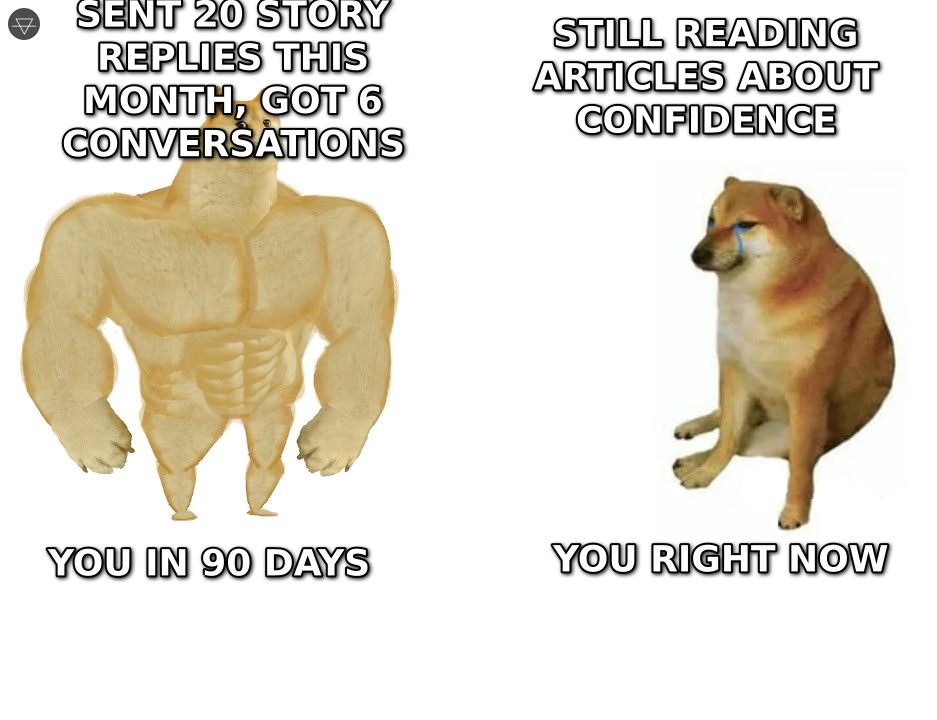
Here's what happens when you actually follow the progression.
Week 1-2: You react to 10 stories. Nothing happens. Your brain registers: I did a thing. Nothing bad happened. Threat model adjusts by 2%.
Week 3-5: You send 10 to 15 story replies. Three women reply back. Two conversations go nowhere. One is actually fun. Your brain registers: I initiated contact with a stranger, she responded positively, and I didn't die. Threat model adjusts by 15%.
Week 6-8: You send your first cold DMs. The anxiety is still there but it's quieter. You send five. Two get replies. One leads to a date. Your brain registers: I can do this. The evidence is overwhelming. Threat model adjusts by 30%.
Month 3 and beyond: Sending a DM feels like sending a text to a friend. Not because the stakes changed. Because your nervous system recalibrated based on evidence. The cortisol response is 80% weaker than it was on day one. You're the same person. Same brain, same wiring, same personality. But with 40 data points proving that the catastrophe your amygdala predicted never materialized.
This is not motivational nonsense. This is how exposure therapy physically restructures neural pathways. The inhibitory learning model shows that new safety associations don't erase the old fear memory. They compete with it. And with enough repetitions, the safety memory wins. Permanently. At four-year follow-up, 90% of patients maintained their improvement.
You are not waiting for confidence to arrive. You are manufacturing it through repetition. Every DM you send is a brick in the wall between you and the guy who Googles "how to be more confident with women" and never does anything about it.
The Profile Problem
None of this works if your profile looks like a ghost account. She is going to click your name before she reads your message. Every time. If your grid is empty, your bio is blank, and your profile photo is a sunset, the best opener in the world won't save you. Your confidence progression stalls because the problem isn't your approach. It's your profile.
Fix it before you start. Clear face photo. Bio that says one thing about who you are. Six to nine posts that show a real life. We wrote the complete breakdown in what girls look for on Instagram. This is the prerequisite. Not the main event.
Try Piercr
You now understand the neuroscience. You have the progression. You know why DMs are the training ground and you know what confidence actually is. The only thing left is reps.
Confidence comes from knowing you've got something real to say. Drop her handle and Piercr reads her Instagram — her posts and the accounts she follows — then gives you a plain-English read on what she's into and the best way to open. No generic compliments, no overthinking — just a specific, honest reason to reach out. You write the message; Piercr makes sure it's about her.
Try Piercr free — your first read is on the house — and start building confidence that compounds.
FAQ
Q: Can you actually build confidence with women or is it something you're born with?
A: Confidence is not a fixed trait. Albert Bandura's self-efficacy research demonstrates that confidence is built through four mechanisms: mastery experiences (succeeding at progressively harder tasks), vicarious learning (watching others succeed), verbal encouragement, and managing your physiological state. DMs provide a low-stakes environment for accumulating mastery experiences without the cortisol spike of face-to-face rejection.
Q: Why do I freeze up when I try to talk to women?
A: Your brain processes social rejection through the same neural pathways as physical pain. An fMRI study at UCLA found that the anterior cingulate cortex, the same region activated by physical injury, lights up during social exclusion. Your freeze response is your nervous system treating a potential rejection as a threat to survival. It's a biological response, not a character flaw, and it can be retrained through progressive exposure.
Q: How do DMs help with dating confidence?
A: DMs reduce the variables that trigger approach anxiety. There's no audience watching you get rejected, no real-time pressure to respond, and no physical fight-or-flight cues. Text communication reduces cognitive load by 40 to 60% compared to voice conversations. This lower stress environment lets you practice the core skill of initiating contact with women repeatedly without the cortisol flood that reinforces avoidance behavior.
Q: What is the best way to start building confidence with women online?
A: Use a progressive exposure model. Start with story reactions, which require zero words and zero risk. Graduate to short story replies that reference her content. Then move to cold DMs with specific openers. Each step builds evidence that initiating contact does not result in the catastrophic outcome your brain predicted. Exposure therapy research shows 90% of patients maintain significant anxiety reduction after an average of four years.
Q: How long does it take to build real confidence with women?
A: Clinical research on exposure therapy for social anxiety shows meaningful improvement within 12 to 16 sessions over 3 to 4 months. In practice, most men report that after sending 15 to 20 story replies and receiving even a handful of positive responses, the anticipatory anxiety drops significantly. The timeline depends on consistency. Confidence compounds through repetition, not time.