
The Talking Stage: What It Is, How Long It Lasts, How to Move It Forward
The short version
- The talking stage is the stretch after the first messages and before anyone has asked for anything: no date on the calendar, no label, just two people messaging and waiting.
- It stalls more often than it fails. Three quarters of Hinge daters say they have been stuck in chats that never turned into a date.
- Before a first date, a talking stage should be measured in days or a couple of weeks. The months people quote are for the whole run up to a relationship, not for texting a stranger.
- It moves forward when someone suggests something specific. In one study of 195 young adults, being asked was the most agreed trigger for leaving the talking stage.
- If you want out, say so in one honest message. Silence is the easy exit and the one people hold against you.
In This Post
- What is a talking stage?
- Why it stalls
- What most guys get wrong
- How long should a talking stage last?
- How to move it forward
- Moving or stalling: how to tell
- What it looks like in the DMs
- Talking stage vs situationship
- How to end a talking stage
- Your move
- Talking stage FAQ
What is a talking stage?
The talking stage is the period where you and someone you like are messaging regularly, the interest is clearly mutual, and nobody has made a move that turns it into something. No date has happened, or one has and the second has not been planned. Nothing is exclusive. Nothing has a name.
That is the whole talking stage meaning. It is the gap between the first messages and the first real plan, and for most guys under 35 it lives in Instagram DMs: story replies and memes, in a conversation that picks up every evening and goes nowhere in particular.
People argue about whether it is a real stage or a stalling tactic with a name. Both are true. It is useful for about as long as you are learning something, and after that it is a waiting room.
Why it stalls
You would think mutual interest plus daily messages adds up to a date by default. It does not. Hinge's relationship scientist put a number on it this year: three quarters of Hinge daters surveyed have gotten stuck in chats that never turned into dates.
Usually both people want the same thing, and neither wants to be the one who asks.
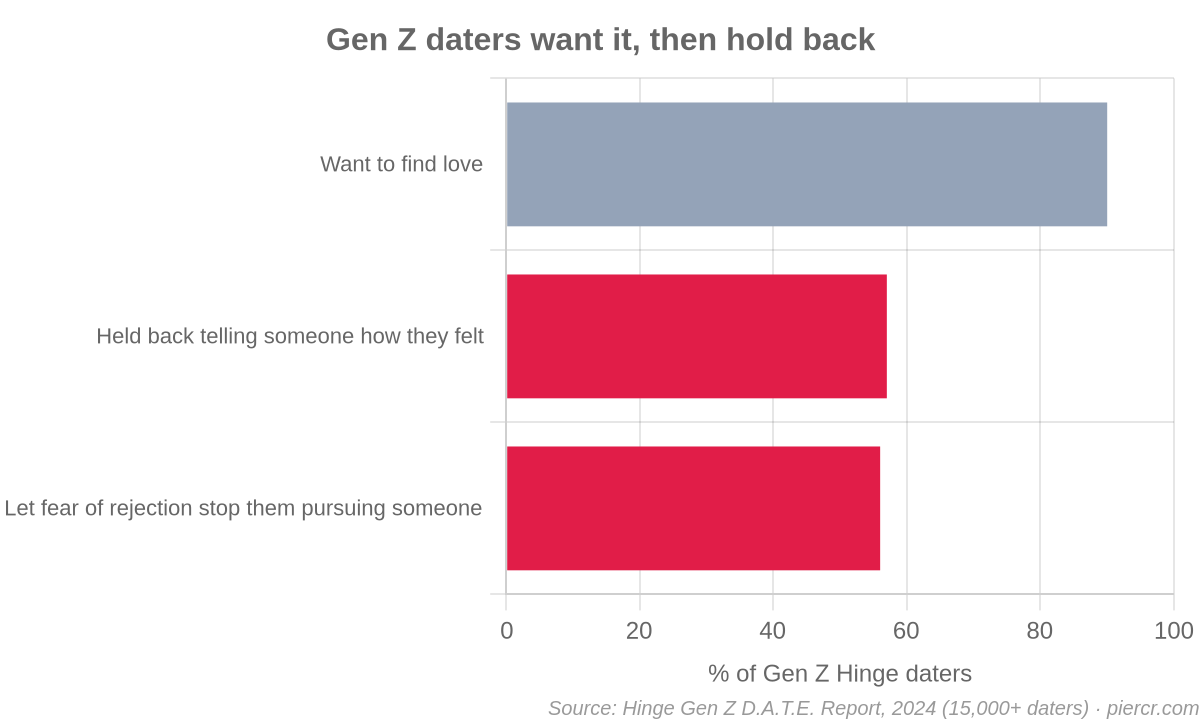
Source: [Hinge Gen Z D.A.T.E. Report, 2024](https://hinge.co/press/2024-GenZ-Report)
Read the gap in that chart. 90% of Gen Z Hinge daters want to find love, and more than half have let the fear of rejection stop them pursuing someone. The talking stage is what that gap looks like from the inside. Two people, both interested, both waiting for a clearer sign before risking anything.
There is a second reason, and it is less flattering. Pew found that 64% of men who use dating apps felt insecure about how few messages they got, while 54% of women felt overwhelmed by how many they got. Your talking stage is probably her third conversation of the evening. A chat that is pleasant and directionless is easy for her to let drift, because nothing in it asks her to choose.
What most guys get wrong
Picture five weeks of it with a girl you met at a friend's birthday. You message every day. You know her flatmate's name, her opinion on every film released that year and what she has for lunch most Tuesdays. You never ask her out, because the conversation is going so well that asking feels like it might break it. Then the replies get shorter, then they stop, and a month later she is posting someone else on her story.
The mistake is treating the messages as the relationship, when they are only the run up to one. Five weeks of run up, and no jump.
Most of the mistakes in the talking stage are versions of that:
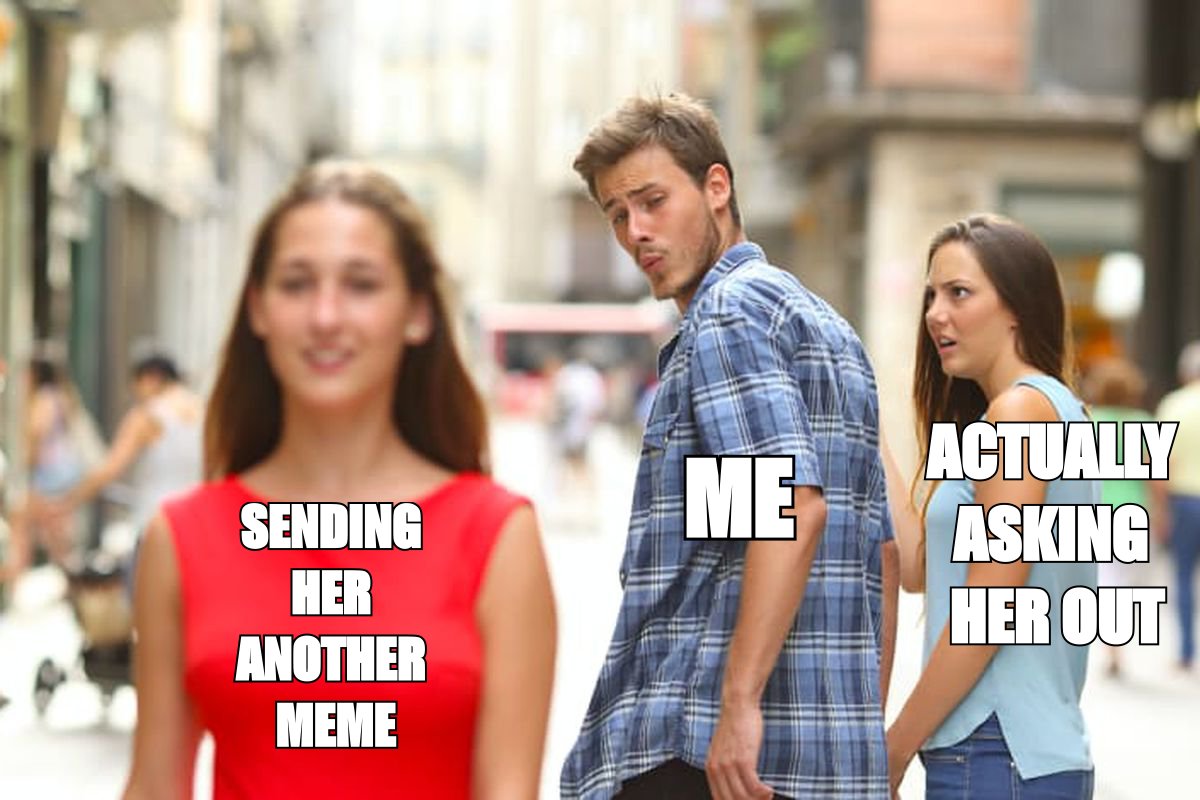
- Counting volume as progress. A hundred messages about nothing is not further along than ten. It is the same place with more scrolling.
- Playing the reply timing game. Gen Z Hinge daters are 50% more likely than millennials to delay a reply so they don't look too keen. If you are both doing it, you have built a conversation out of strategic pauses. There is a real point about not being too available, but timing games are not it.
- Reading tea leaves instead of asking. 56% of Hinge daters admit they have overanalysed someone's texting habits: emojis, punctuation, message length. The analysis rarely tells you anything a direct question would not.
- Waiting for her to make it official. She may be waiting for exactly the same thing.
How long should a talking stage last?
Shorter than you think, and it depends on which talking stage you mean.
There are two. One is messaging someone you have not met yet, or barely know. The other is the stretch after a date or two, before either of you has said what this is. People use the same phrase for both, which is why the answers online range from "a few days" to "six months".
That range is for the whole thing, from first interest to being exclusive, and it usually includes dates. It is not permission to text a girl you have never met for four months.
For the first kind, the pre date talking stage, the useful window is short. Long enough to know there is something to talk about and that she is responsive. After that, every extra week of messaging raises the stakes of the first meeting without telling you anything new. You end up with a version of her built from text, and then you meet the real one.
Brett Gray, the actor from Netflix's On My Block, gave the most blunt version of this on an Instagram Live:
If I meet you and I like you and we've been texting every day... after about four or five days of that, I need to see you because that's about time for a first date.
Four or five days is fast if you are nervous. The principle holds anyway. If you have been talking every day for two or three weeks and nobody has suggested meeting, the talking stage is no longer collecting information. It is just running.
For the second kind, the post date talking stage, the clock is looser. A few dates over a month or two before anyone defines anything is normal. What is not normal is months of dates with no conversation about what it is, which is where it starts turning into something else (more on that below).
How to move it forward
The ECU study found something worth repeating: across singles, people in a talking stage and people already dating, the most agreed trigger for moving from talking to a committed relationship was simply being asked. Not a sign. Not a vibe shift. Someone asking.
So the playbook is mostly about making the ask easy to say yes to.
1. Use the talking stage to learn one real thing about her. Not her favourite colour. Something she actually does: the climbing gym she posts from, the band she has seen three times, the market she goes to on Sundays. This is what the stage is for. A good set of questions for your talking stage helps, but most of the answers are already on her profile if you look at what she does rather than what her bio says.
2. Turn that thing into a plan. "We should hang out sometime" is a talking stage extender. "There's a bouldering place near you that does a beginners night on Thursday, come and laugh at me" is a plan. One of these needs another week of messages to resolve. The other needs a yes or a no.
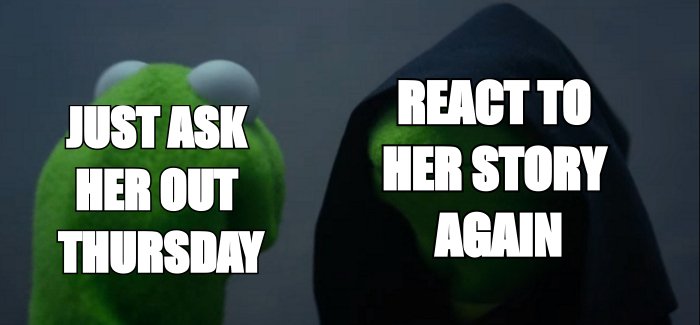
3. Ask while the conversation is warm. The best moment is mid flow, when she has just sent something enthusiastic. Not after a two day lull, when the ask has to restart the whole thing. If you need more on the mechanics, getting from DMs to a date covers the full sequence.
4. Make it a small ask. A drink, a walk, an hour at something she already likes. Our first date ideas are sorted by what she is into for exactly this reason. Small asks get yeses.
5. If it goes well, say so. After a date or two, the talking stage ends the same way it started: someone says the thing. "I like spending time with you and I'm not seeing anyone else" is a complete sentence.
Logan Ury, who leads relationship science at Hinge, named the fear behind most stalled chats:
Asking someone out is nerve-wracking. What if they're not ready to meet up? What if you suggest the wrong plan?
The wrong plan is the one built on nothing. A plan built on something she has shown she cares about is hard to get wrong, because the question has already been half answered.
Moving or stalling: how to tell
| Stalling | Moving |
|---|---|
| You talk every day but nothing in it points at meeting | There is a plan, or a plan is being negotiated |
| Conversation runs on memes and story reactions | She tells you things she would not post |
| She answers questions but rarely asks any | She asks follow ups and remembers details |
| Replies come at the same slow pace whatever you send | Replies speed up when the subject is something she cares about |
| "We should hang out sometime" has been said three times | A day and a place have been said once |
| You start every conversation and suggest every plan | She starts some of them, and offers alternatives when she can't make yours |
| You are still at the stage after three weeks that you were at after three days | Each week has moved one step: a call, a date, a second date |
If the left column looks familiar, more messages won't fix it. A specific suggestion will, and her answer will tell you more than another week of reading whether she likes you.
Knowing the one real thing to build a plan on is the part most guys skip, because it means actually knowing her. Piercr does that part: type her Instagram username and you get what she is genuinely into, so the plan you suggest is about her rather than about anyone.
What it looks like in the DMs
The difference between a talking stage that moves and one that drifts usually comes down to one message. Here is the same moment, done two ways.
Ending the stall, generic vs specific
a real place she already cares about, a real day, and an easy yes or no
says what you want plainly instead of asking her to define it for you
Neither of the right hand messages is clever. They are clear, and in the talking stage clear is rarer than clever.
Say she posts a lot from one particular second hand bookshop, and you have been chatting for about ten days. A version of the first one fits: go there and each pick a book for the other. That kind of message tends to get the fastest reply of the whole conversation, because it is the first one that asks her for anything.
Talking stage vs situationship
A talking stage is temporary by design. Both people understand it is a run up to something. A situationship is what you get when the run up never ends: you are seeing each other, maybe sleeping together, maybe acting like a couple, and nobody has said what it is or whether it is going anywhere.
The difference is direction. A talking stage that stays undefined after weeks of dates is not a talking stage any more. It has become an arrangement, and arrangements tend to stay arrangements because changing them requires the same conversation that was avoided in the first place.
The same survey found over 62% of respondents still liked the talking stage because it helped them judge compatibility. That is the honest version: the stage is useful when it is short and has a direction, and miserable when it has neither. Among those who had deleted an app over it, 80% said they spent one to five hours a week on talking stage conversations that went nowhere.
If you are not sure which one you are in, ask yourself whether either of you has said what you want. If nobody has, you are drifting toward the second one.
How to end a talking stage
Sometimes the answer to "how do I move this forward" is that you don't want to. Maybe the conversation is fine and the interest is not there. Maybe you have met someone else. Either way, ending a talking stage takes one message, and most people skip it.
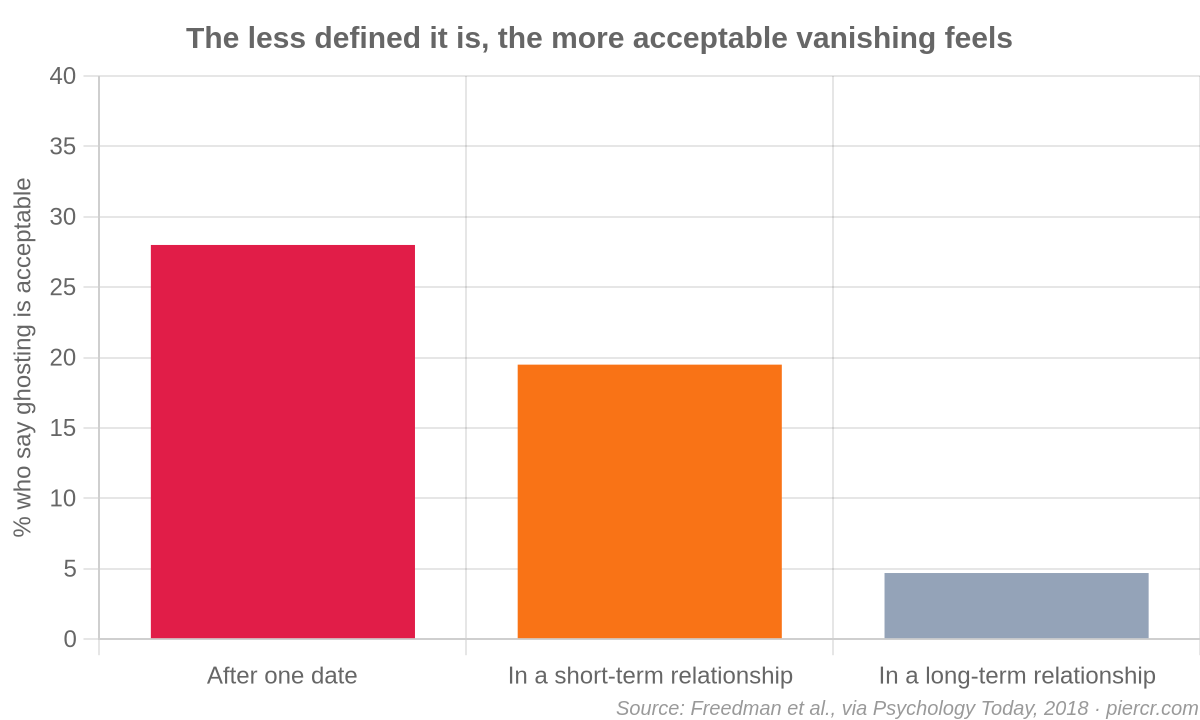
Source: [Freedman et al., summarised in Psychology Today, 2018](https://www.psychologytoday.com/us/blog/close-encounters/201803/what-do-we-know-about-ghosting)
The research on ghosting, summarised by psychologist Gwendolyn Seidman, found that about 25% of people had been ghosted by a partner and about 20% had ghosted someone. The chart shows why the talking stage is where it happens most: the less defined the connection, the more acceptable disappearing feels. 28% thought ghosting was fine after a single date.
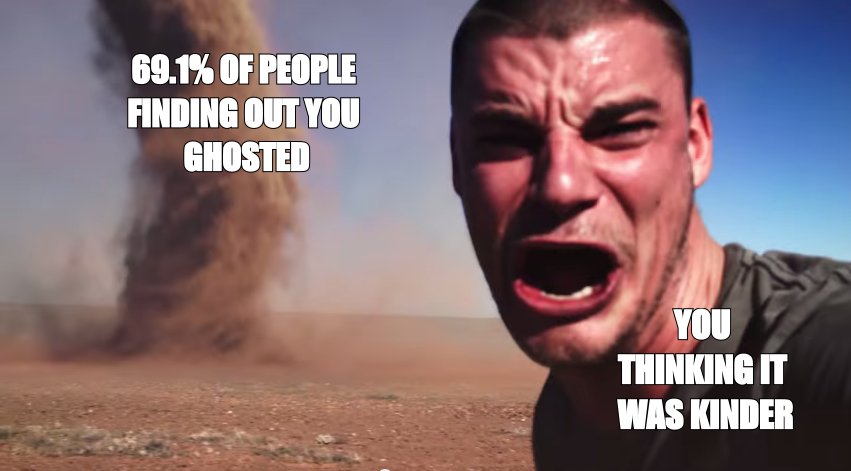
The same work found that 69.1% would think more negatively of someone if they learned that person had ghosted a partner. Fading out feels kinder in the moment. It is mostly just easier for you.
A clean ending is short. Say you have enjoyed talking, say you don't see it going further, wish her well. Skip the list of reasons, and do not leave a door half open so you can come back when you are bored. If she is the one who ends it, take it at face value. Handling rejection is easier when the message was honest, and you will want the same courtesy when it is your turn.
Don't confuse a slow week with an ending
People get busy. One slow day is not a fade, and a girl who has gone quiet for 48 hours has not necessarily ended anything. If she has stopped replying entirely, that is a different situation with its own rules, and the post on being left on read covers it.
If she has gone quiet rather than ended it, being left on read has its own playbook, and it is mostly about not sending four follow ups.
Your move
Get out of the talking stage
- Decide which talking stage you are in: before the first date, or after a few.
- If you have been messaging daily for two or three weeks with no plan, stop adding messages and suggest something.
- Build the plan on one real thing she cares about, not a generic drink.
- Ask while the conversation is warm, with a day and a place.
- After a few good dates, say what you want in one plain sentence.
- If you want out, send one honest message instead of fading.
The talking stage is not a problem in itself. It turns into one when it stops being a step and starts being the whole thing. Someone has to suggest the plan, and it may as well be the person who knows what she would actually say yes to. If that is the part you are stuck on, Piercr gives you her real interests from her Instagram username, so the ask is built on her.
Talking stage FAQ
What does talking stage mean?
It means two people are messaging regularly, the interest is mutual, and nothing has been made official or even planned. It sits after the first messages and before dating properly. For most people under 30 it happens over DMs and texts.
How long should a talking stage last?
Before a first date, a week or two of regular messaging is usually enough to know whether to meet. The 1 to 6 month figures you see quoted describe the whole path from first interest to a committed relationship, including dates, not how long to text before meeting.
What is the difference between a talking stage and a situationship?
A talking stage is a short run up that both people expect to lead somewhere. A situationship is a connection that has kept going, often including dates or sex, without anyone defining it or saying where it is going. A talking stage that never gets defined usually becomes one.
How much should you text during the talking stage?
Enough that the conversation has a rhythm, not so much that it replaces meeting. Daily messages are normal. Hours of messaging every day for weeks with no plan is usually a sign the texting has become the substitute for a date.
Is it okay to talk to other people during the talking stage?
Usually, yes, unless you have both agreed otherwise. Nothing in the talking stage is exclusive by default, which is exactly why it is worth saying out loud when you want it to be.