
AI Dating Advice: What It Fixes and What It Quietly Ruins
Key takeaways
- Most AI dating advice fixes the wrong problem. Your message is not badly written. It is about nobody in particular.
- AI is genuinely good at nerves, structure and the second draft. It cannot know a single thing about her that is not already public.
- 84% of dating app users say AI content has made dating harder to trust, and 60% believe they have already been messaged by one.
- The tell is almost never the wording. It is the punctuation, the rhythm, and a sudden jump in how polished you sound.
- Use it to think, not to type. The moment it sets your voice, you have to keep being that guy.
In This Post
- Why AI Dating Advice Feels Right and Lands Wrong
- What Most Guys Get Wrong About Using AI for Dating
- What AI Actually Knows, and What It Cannot Know About Her
- How to Use AI for Dating Without Sounding Like a Bot
- ChatGPT for Dating: The Wrong Way vs the Right Way
- Real Examples: Openers AI Writes vs Openers Only You Could Send
- What the Research Says About AI in Dating
- Watch-Outs: Where AI for Dating Apps Turns on You
- Your Move
- Frequently Asked Questions
- Related Articles
Why AI Dating Advice Feels Right and Lands Wrong
You open a tab, paste in her profile, and ask for something clever. Twelve seconds later you have a message that is grammatically perfect, warm, mildly funny, and completely interchangeable with the one the next guy just generated from the same profile.
That is the whole problem in one paragraph, and almost nobody selling AI dating advice will say it out loud.
The adoption numbers are not small any more. 26% of single Americans now use AI somewhere in their dating life, a 333% jump in a single year, according to Match and the Kinsey Institute survey of 5,001 US singles. In the UK the message-specific figure is sharper: 32% of dating app users have AI coach or write their messages to potential partners.
So roughly a third of what lands in her inbox has been through a model. She knows that. Everyone knows that.
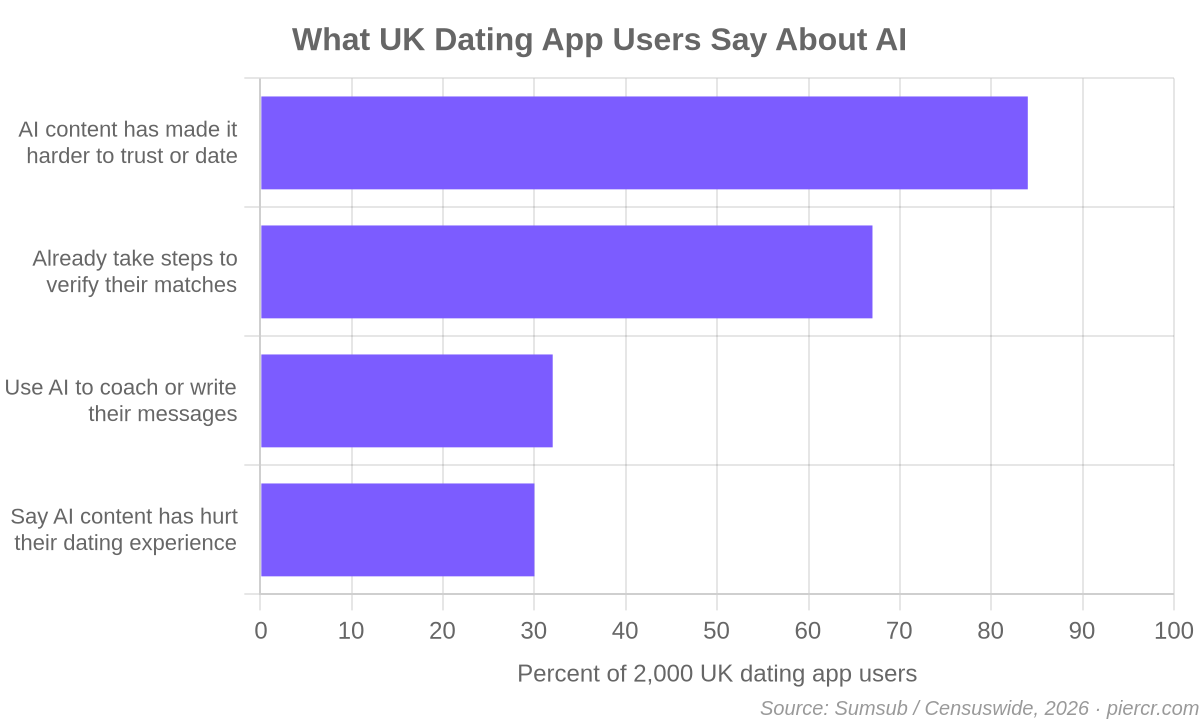
Source: Sumsub and Censuswide, 2026
The same survey found that 84% say AI-generated content has made it harder to trust people or date successfully, and 67% now take active steps to verify who they are talking to. A third of people are using the tool. Most people think the tool has wrecked the thing they are using it for. Both groups are the same people.
I ran one match's profile through three different tools in a single sitting once, out of curiosity. All three came back with a version of the same joke about her ski photo, because the ski photo was the only thing any of them could see. I sent the best one. Nothing. The tools were not wrong. They just had exactly the same information as the forty other guys with the same tab open.
Can AI help with dating?
Yes, in a narrow and slightly boring way. It will get you unstuck when you have been staring at an empty box for ten minutes. It will tell you your message is too long, because it is. It will catch that you asked three questions in a row and made her do all the work.
What it will not do is tell you anything true about her. That distinction runs through everything below.
What Most Guys Get Wrong About Using AI for Dating
The assumption underneath most AI dating advice is that you are losing because your wording is weak. Fix the wording, win the reply.
That is not what is happening. You are losing because the message could have been addressed to anyone with a similar profile, and she can feel that in about a second and a half.
The default assumption has also flipped. 60% of current online daters believe they have already had a dating app conversation that was written by AI. You are not being read as a guy who might have used a tool. You are being read as a guy who probably did, unless something in the message proves otherwise.
Spend a week reading r/OnlineDating or r/dating_advice and one complaint keeps surfacing from guys who are doing everything right on paper. They mention something from her bio. They ask a personalised question. The conversation still dies after two messages. This is anecdote rather than data, but it is remarkably consistent anecdote, and it points somewhere useful.
Meanwhile r/Tinder has turned suspicion into a spectator sport. A recurring post format there is a screenshot of an opener with the caption asking whether this was written by a bot, and the comments arrive fast and unkind. Nobody in those threads is analysing grammar. They are reacting to a message that reads borrowed.
Here is the reason that advice stopped working. "Reference something from her bio" was good advice in about 2019. Now every tool gives the same instruction, and her bio is the one part of her profile that every single person already read. Referencing it proves nothing. Bios say the same two things over and over precisely because they are written to be read by strangers.
Specificity is not the same as personalisation. Personalisation means you mentioned a detail. Specificity means the message could not have been sent to anyone else.
What AI Actually Knows, and What It Cannot Know About Her
A language model is extraordinary at one thing: producing the most plausible next sentence, averaged across an enormous amount of human writing. That is genuinely useful for a cover letter. It is close to useless for the question you actually have, which is whether this specific woman wants to talk to you.
There is a study that settles this better than any opinion. In 2017, psychologist Samantha Joel and her colleagues ran machine learning over speed-dating data, using more than 100 self-reported traits and preferences, to try to predict romantic desire. They could predict how much a person tended to like others in general, and how much they tended to be liked. On whether two specific people would want each other, the model returned nothing.
I thought that out of more than 100 predictors, we would be able to predict at least some portion of the variance. I didn't expect we would find zero.
That was a purpose-built model with clean data from people who had physically met. Your chatbot has four photos and a caption.
So the honest division of labour looks like this. The model handles language. You have to handle information. And information about a person is not something you can prompt your way to.
I learned this the annoying way. Four days into a conversation that was going fine, I used AI to draft a reply. What came back was better written than anything I had sent her all week. That was the problem. She had been replying within minutes; that message took eleven hours to get an answer. Nobody accused me of anything. The temperature just dropped.
How can AI help with dating?
Concretely, and without overselling it:
- Nerves. Getting a first draft out of your head so the box is not empty.
- Length. Telling you the message is twice as long as it should be.
- Balance. Spotting that you interviewed her instead of talking to her.
- Second drafts. Tightening a sentence you already wrote in your own words.
- Reading the room after the fact. Sanity-checking whether a reply was warm or just polite.
None of those require it to know her. All of them are real. That is the actual job description, and it is a smaller job than the ads suggest. If you want the version of this focused on message mechanics rather than tools, the rules that beat better lines covers it.
The division of labour
The model handles language. You handle information. Every time a tool disappoints you, check which of those two you actually needed, because it is almost always the second one.
How to Use AI for Dating Without Sounding Like a Bot
Five rules. They are restrictive on purpose.
1. Feed it what you noticed, not what she posted. Do not paste her profile in and ask for an opener. Write two sentences about the thing that actually caught your attention, then ask it to tighten them. The raw material has to come from you, because the raw material is the only part that is yours.
2. Ask it to critique, never to compose. "What is weak about this message?" gets you a better message than "write me a message." The first keeps your voice. The second replaces it.
3. Cap it at one sentence. If more than one sentence in your message came out of the model, you have crossed from editing into ghostwriting, and you will not be able to keep it up.
4. Never let it set the register. Models default to smooth and slightly formal. If that is not how you talk, the gap between your messages and your actual conversation becomes obvious fast.
5. Do the reading yourself. Whatever you open with, you should be able to explain why it applies to her and to nobody else. If you cannot, the message is not ready.
AI to talk to girls: where it breaks
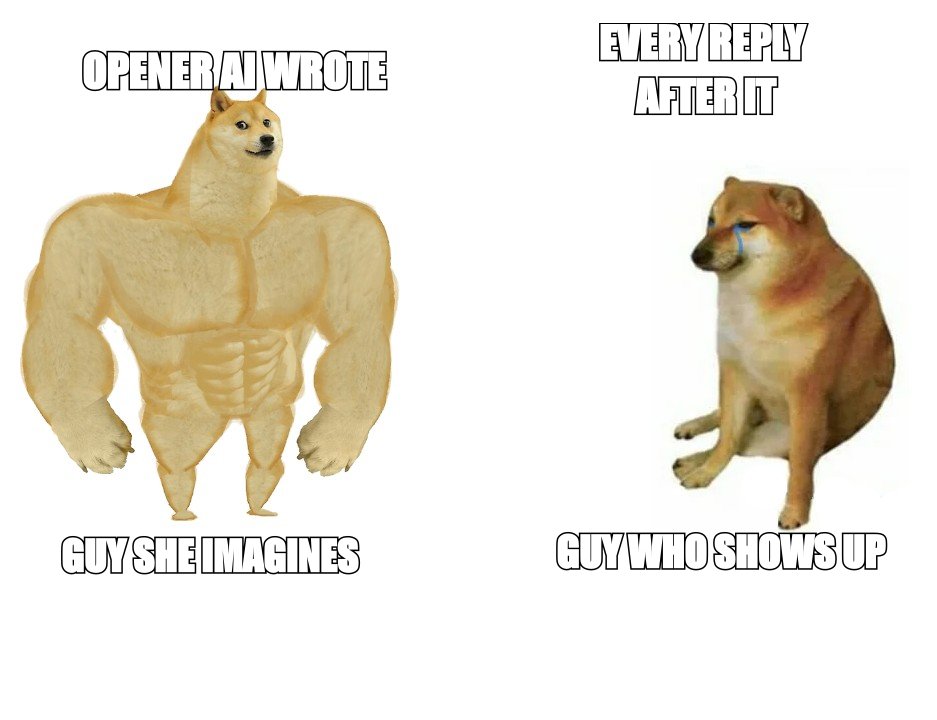
It breaks at the second message. The opener is the easy part, and a model can carry you through it. Then she replies, and you are in a live conversation as a version of yourself you cannot sustain. Guys describe this constantly: the reply that goes quiet after a strong start.
You cannot outsource the opener and then show up as yourself in message four. She notices the seam.
ChatGPT for Dating: The Wrong Way vs the Right Way
The difference is not which model you use. It is what you ask it for.
| Asking it to write | Asking it to think |
|---|---|
| Here is her profile, write me an opener | Here is what I noticed and why. Is that interesting or is it obvious? |
| Make this funnier | Is this trying too hard? Be blunt |
| Write a reply to this message | She said this. What is she actually asking? |
| Give me 10 openers | Which of these two sentences sounds more like a person and less like a caption? |
| Rewrite my whole message | Cut this to half the length without changing the words I chose |
The left column produces text that is better than yours and less useful. The right column produces a slightly better version of you.
If you want the tools themselves compared rather than the method, we went through the assistants side by side, and separately looked at what rizz apps actually do once you strip the marketing off.
Real Examples: Openers AI Writes vs Openers Only You Could Send
Every pair below shows the same underlying observation. The left version is what a model produces from a profile. The right version is what someone produces after actually looking. These illustrate a principle. Do not send them verbatim, because the entire point is that they would not apply to her.
Fluent vs. specific
a model can see travel photos. It cannot see the one where the mood breaks
requires having looked at more than one post, which is the part that cannot be faked
reads a pattern rather than a caption, and it is a real question with a real answer
None of that needs a model to phrase it. All of it needs information the model does not have.
That is the actual bottleneck, and it is why we built Piercr to hand you the read on the person instead of a line to paste. You get what she is into and what she cares about. What you say next is still yours.
What the Research Says About AI in Dating
The industry's own ambition here is worth hearing, because it is stranger than anything a critic would invent. At the Bloomberg Technology Summit in May 2024, Bumble founder and executive chair Whitney Wolfe Herd described where she thought this was going.
If you want to get really out there, there is a world where your dating concierge could go and date for you with other dating concierge.
Two AI agents having a conversation so that two humans do not have to. Hold onto that image, because it is the logical end point of treating the message as the problem.
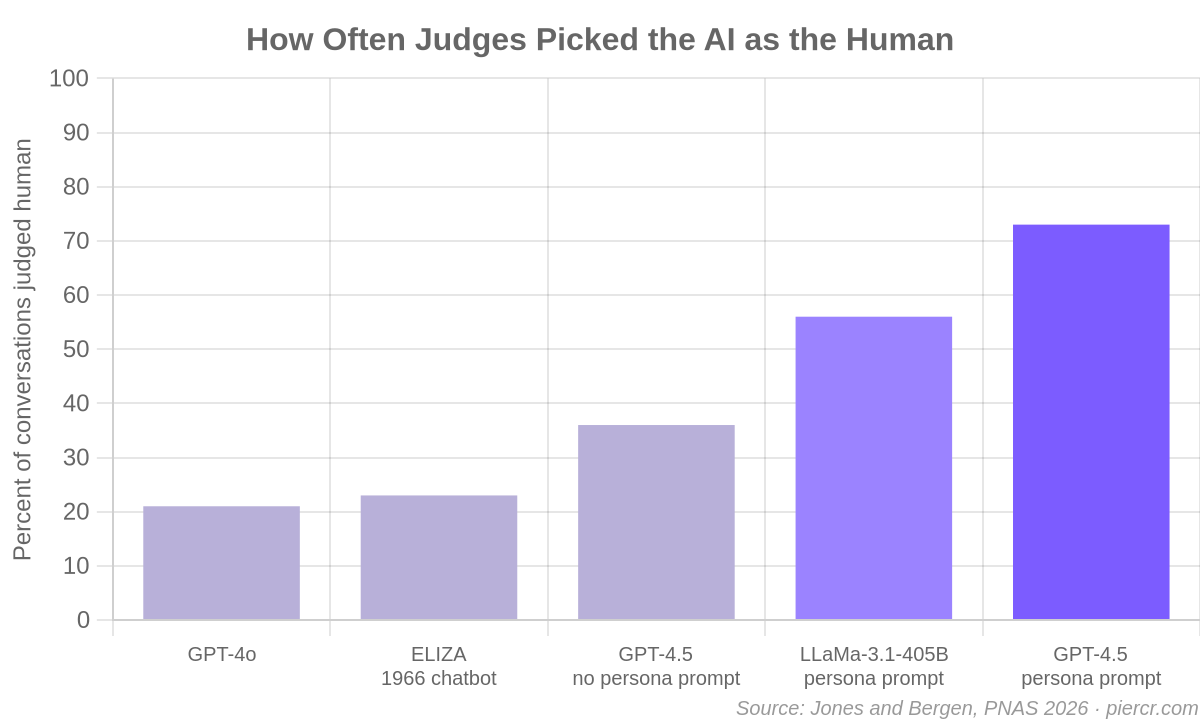
On whether she can tell, the research is less comforting than you want and more interesting than you expect. In a study published in the Proceedings of the National Academy of Sciences in May 2026, judges held five-minute text conversations and tried to pick the human. GPT-4.5 was judged to be the human 73% of the time.
Source: Jones and Bergen, PNAS 2026
Look at the third bar. Without a persona prompt, the same model dropped to 36%. Same system, same conversations, half the score. What made it pass was being told exactly who to be.
Cameron Jones, the study's corresponding author and now an assistant professor of psychology at Stony Brook, put the finding plainly.
It's relatively easy to prompt these models to be indistinguishable from humans.
Which answers "can she tell", and also explains why most people get caught. Nobody writes a persona prompt before asking for an opener. They type "write me something funny for a girl who likes hiking" and paste what comes back. That output is not disguised as anyone. It reads as the average of everyone.
Watch-Outs: Where AI for Dating Apps Turns on You
Most of the damage here happens around the message rather than inside it.
She will judge the tool differently than you do. 61% of online daters say they would trust an AI coach more than a human friend or family member for relationship advice, from a Norton survey of 14,003 adults across 14 countries. In the same survey, 64% said it would bother them to find out their match used AI to draft their prompts or modify their pictures. Same respondents. Using it is sensible; being caught using it is a betrayal.
The disclosure is riskier than the use. Threads surface on r/dating_advice where a guy casually mentions he asked a chatbot about something, and the reaction from his match is immediate and cold. The messages were never the issue. Saying it out loud was.
The tell is formatting, not vocabulary. Women describing this pattern almost never say the words were wrong. They point at spacing, punctuation, a rhythm that does not match how the person talks anywhere else, and a polish that arrived from nowhere on a Tuesday. Anecdote again rather than evidence, but it lines up with the persona-prompt finding: the mismatch gives it away, not the content.
Even the advice forums have stopped tolerating it. r/hingeapp runs an explicit no-AI rule and has had to remind people of it, after moderators noticed a rise in AI-written comments on profile reviews. The place people go for help with their dating profile now bans the tool people are using to write them.
The stated position is hardening. A 2026 Match Group survey of 1,000 people aged 18 to 39 found 47% hold a negative view of AI's use in romantic contexts, and 40% would refuse to date someone who uses an AI companion app, rising to 51% among women aged 18 to 24. The same survey found 64% could see how AI might help them, which is the tension in a sentence.
The part nobody plans for
If AI writes your opener, you have to keep being that guy for the next three weeks. Most people cannot, and the gap between message one and message twelve does more damage than a mediocre opener ever would.
Worth knowing too: 30% of UK dating app users say AI-generated content has directly hurt their dating experience, and 28% do not trust themselves to spot an AI-manipulated profile. She is more suspicious than she was last year and less confident in her own judgement. That combination makes people default to no.
If you want the underlying skill rather than the tooling, working out what she is actually into and reading what her Instagram says about her are the two that matter most here.
Your Move
Your move
- Before you open any AI tool, spend five minutes on her profile and write down one thing that is not in her bio.
- Draft the message yourself, badly. Speed matters more than quality at this stage.
- Ask the model what is weak about it. Do not ask it to rewrite it.
- Change one sentence at most, and keep your own words wherever you can.
- Read it back and ask whether it could be sent to anyone else. If yes, start again.
- Once she replies, close the tab. The rest has to be you.
The tool is a decent editor with no eyes. Give it something to look at.
If you would rather start from what she is genuinely interested in, put her Instagram username into Piercr and read the brief before you type anything. The message will sound like you, because you will finally have something worth saying.
Frequently Asked Questions
Can AI help with dating, honestly?
Yes, for a narrow set of jobs: getting past a blank box, cutting length, catching that you asked too many questions. No, for the job people actually want, which is knowing what to say to one specific person. It has no information about her that you do not already have.
Can she tell if I used ChatGPT to write my message?
Usually not from the words. From the punctuation, and from a level of polish that does not match how you write anywhere else. The research supports the mechanism: models only read as human when they are told exactly who to be, and nobody bothers doing that before generating an opener.
Is using AI on dating apps cheating?
It is not cheating, and that framing misses the risk. 64% of online daters say it would bother them to learn their match used AI, which makes it something more awkward than cheating in practice. It is a dealbreaker you cannot explain your way out of once it surfaces.
What is the best AI wingman?
Wrong question, and every roundup that answers it is selling something. The tools are broadly the same because the models underneath are broadly the same. What varies is whether a tool gives you information or gives you text. Text you already have. If you want the comparison anyway, we ranked them.
Why does the AI message sound nothing like me?
Because it is producing the statistical average of how people write, and you are not average. That smoothness is the exact quality that reads as generated. If you keep rewriting the output to sound like yourself, you have already spotted the problem, and the fix is to stop generating and start editing.